Launched this week
SolopreneurOS

SolopreneurOS

The operating system for one-person businesses

4 followers

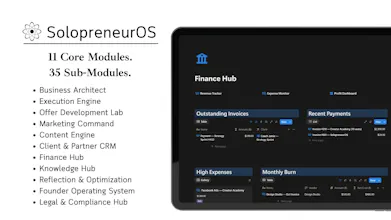
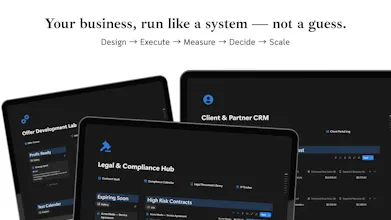
Complete business operating system for solopreneurs. Calculate real profit margins per offer, auto-score tasks by business impact, forecast revenue, track burn rate and runway. See which marketing channels actually work and which clients are profitable. All in a single interconnected system. 11 interconnected modules that show you the truth about your business so you can make smart decisions based on data instead of gut feelings. Stop guessing. Start operating.
SolopreneurOS gallery image
Payment Required
Launch Team
agent by Firecrawl
agent by Firecrawl
Gather structured data wherever it lives on the web
Promoted

What do you think? …

Divyendu Lakwad
Hey Product Hunt 👋 I'm Divyendu, and I'm honestly nervous to ship this one. Not because it's not ready, it is. But because this template is different from everything I've built before, and I'm not sure if I've translated what I see in my head into something that makes sense to anyone else. The short version of how this happened: I've been trying to build something meaningful for years, bouncing between too many interests (writer, poet, programmer, law student, content creator), always starting over, always losing track. Classic creative chaos. So I started building Notion systems to survive it. WritersOS for unfinished novels. PoetryOS for scattered verses. BookOS after I literally forgot who I loaned a book to. PolymathOS for managing learning in twelve directions at once. HealthOS after an asthma diagnosis made health management suddenly non-negotiable. Each one was built from necessity, not ambition. Then I hit a different wall. I was making enough to keep going, selling templates, doing some consulting, building things, but I had zero idea if I was actually building a business or just staying busy. Which offer made money? No clue. Which marketing worked? Gut feel. Was I profitable? Hopefully? I had revenue. I had clients. But I was making decisions with zero dollars of data. That's when it hit me: I'd built operating systems for every part of my life except the business itself. So I built SolopreneurOS the same way I built everything else, by modeling the problem correctly first, then building the structure to solve it. What makes this different from my other templates: This isn't a productivity system. It's business infrastructure. Every module is a closed-loop system with inputs, metrics, decisions, and actions. Everything connects through relations and rollups, your offers feed your finance hub, your tasks tie to actual business impact, your marketing rolls up to revenue, your founder energy is treated as the constraint it actually is. The 11 modules: 1. Business Architect - Know your model, margins, and strategic position at a glance 2. Execution Engine - Turn strategy into results with prioritized tasks, project tracking, and performance metrics 3. Offer Development Lab - Systematize validation, pricing, and optimization for products that actually sell 4. Marketing Command - See which channels work and stop bleeding money on ones that don't 5. Content Engine - Track what content actually drives revenue and conversions 6. Client & Partner CRM - Forecast revenue, spot problem clients early, optimize partnerships 7. Finance Hub - Real P&L with margins, burn rate, and runway—know if you're actually profitable 8. Knowledge Hub - Turn learning into measurable leverage with application tracking and impact ROI 9. Reflection & Optimization - Spot problems with KPI monitoring, anomaly detection, and prioritized improvements 10. Founder Operating System - Optimize energy, habits, and life balance for sustainable high performance 11. Legal & Compliance Hub - Manage contracts, track renewals, protect IP, and reduce risk exposure It's designed around a simple idea: if you model the business correctly, execution becomes predictable. What I'm most uncertain about: Is it too much? 11 modules, 35+ submodules, it's comprehensive by design, but does it feel overwhelming at first glance? What I'd love from this community: Sample views → Does the architecture make sense when you see it? Challenge the modules → What's missing? What's redundant? Question the formulas → Are the metrics actually useful or just impressive-looking? Be honest → If this doesn't solve a real problem, tell me. I've been building in public for a while now, and the best feedback I've ever gotten came from people who didn't hold back. So don't hold back. If you've ever felt like you're running a "business" but operating like a collection of to-do lists, I'd genuinely love to know if this resonates. Thanks for being here. — Divyendu