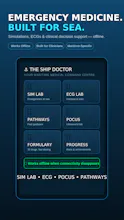
Ship Doctor is an offline emergency medicine training app for clinicians, medics and students working at sea, offshore or far from immediate help. Practise evolving patient simulations, ECG interpretation, POCUS, clinical pathways, calculators and drug references. Maritime variables—including sea state, limited resources, evacuation delays and diversion decisions—make every case operationally realistic.
No reviews yetBe the first to leave a review for The Ship Doctor: Medical Sim
Maker
📌
Hi Product Hunt 👋
I’m Dr Ezekiel Aluda Osolika, an emergency physician who has worked aboard passenger and expedition vessels.
Ship Doctor started with a problem I experienced personally: most emergency medicine education assumes a fully equipped hospital, reliable internet, specialist backup and rapid access to definitive care. At sea, offshore or in a remote clinic, those assumptions can disappear.
I wanted to recreate not only the clinical case, but also the operational pressure surrounding it—the changing patient, finite medical supplies, sea conditions, evacuation window and sometimes the decision to continue sailing, divert or arrange an urgent transfer.
The result is an offline-first Android training app combining evolving emergency simulations with ECG interpretation, POCUS, clinical pathways, calculators and drug references.
Although it was born at sea, I am developing Ship Doctor for doctors, nurses, paramedics, remote medics and students working anywhere help may be far away.
The app is designed for education and simulation—not as a replacement for clinical judgment, approved protocols or certified training.
I built the project independently and continue refining its clinical accuracy, realism and learning experience. I would particularly appreciate your feedback on:
• The realism of the simulations
• Its usefulness for maritime, offshore and remote-care training
• The onboarding experience
• Which scenarios or training modes you would like to see next
Thank you for taking a look. I’ll be here throughout the launch to answer questions and hear your suggestions.
Dr Ezekiel
Report
honestly the sea state variables are a nice touch, kind of forces you to think about real offshore constraints instead of just running through textbook cases. the ECG and POCUS bits felt solid too.
Report
Maker
@esrakalkmazo Thank you, Esra—that was exactly the intention. In remote care, the clinically appropriate plan can change when weather, evacuation time and available resources are constrained. I’m glad the ECG and POCUS components felt solid.
Report
Offline use is huge for ship work. Would love to see a mode where I can log cases and brief notes during a watch, then sync when I hit port, so learning actually sticks beyond the sim.
Report
Maker
@salimelikozixr Thank you, Salim. A watch-based learning log is a very interesting idea. To protect privacy, I would envisage an anonymised personal after-action learning log rather than a clinical patient record—stored offline and synchronised only when chosen. Would quick notes and tags be sufficient, or would a structured SBAR/debrief format be more useful?
Report
The offline-first approach is really smart for the actual environments these clinicians work in. Love that you baked sea state and evacuation delays right into the case logic instead of treating them as optional flavor text.
Report
Maker
@k_rdar67517 Thank you, Meral. I wanted the operational environment to affect the decisions rather than sit in the background as decoration. Distance, weather, resources and evacuation windows can materially change how a case is managed. Which operational variable would you most like expanded?
honestly the sea state variables are a nice touch, kind of forces you to think about real offshore constraints instead of just running through textbook cases. the ECG and POCUS bits felt solid too.
@esrakalkmazo Thank you, Esra—that was exactly the intention. In remote care, the clinically appropriate plan can change when weather, evacuation time and available resources are constrained. I’m glad the ECG and POCUS components felt solid.
Offline use is huge for ship work. Would love to see a mode where I can log cases and brief notes during a watch, then sync when I hit port, so learning actually sticks beyond the sim.
@salimelikozixr Thank you, Salim. A watch-based learning log is a very interesting idea. To protect privacy, I would envisage an anonymised personal after-action learning log rather than a clinical patient record—stored offline and synchronised only when chosen. Would quick notes and tags be sufficient, or would a structured SBAR/debrief format be more useful?
The offline-first approach is really smart for the actual environments these clinicians work in. Love that you baked sea state and evacuation delays right into the case logic instead of treating them as optional flavor text.
@k_rdar67517 Thank you, Meral. I wanted the operational environment to affect the decisions rather than sit in the background as decoration. Distance, weather, resources and evacuation windows can materially change how a case is managed. Which operational variable would you most like expanded?