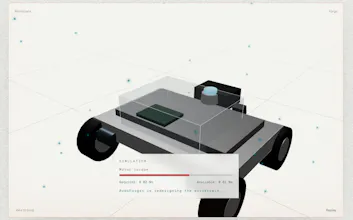
RoboForger turns a robot idea into a buildable design. Describe what you want to build. RoboForger translates the brief into requirements, designs the machine, checks its physics, iterates when something fails, and prepares the files and parts needed to build it. We're starting with robotics, but the bigger goal is making physical engineering as easy to iterate on as software. Describe it. Forge it. Test it. Build it. Early access is now open.
This one started from a dumb realization: we could generate a photo-realistic image of a robot in about 10 seconds. Cool. Then we tried to actually build one. And the picture didn't tell us what motor to buy, whether the drivetrain had enough torque, whether it'd tip over on an incline, or what bracket to print first. Turns out a render has never had to survive gravity.
That gap - between "I can imagine a robot" and "I'm holding one that actually runs" - is what we've spent the last stretch building RoboForger to close.
It's not another AI that draws you a robot. You describe what you want, and RoboForger turns that into real requirements, designs the mechanical parts, runs physics checks against them, and - this is the part we care about most - tells you honestly when something will fail and why, before you've spent a rupee on parts. Then it hands you what you actually need to build it for real: STEP/STL files, a BOM, and a guide to take you through printing, sourcing, assembly, and testing.
We're starting narrow and honest about it - a small set of robot archetypes to prove the whole loop works end-to-end, not a promise to design anything under the sun on day one. Robotics is the wedge; the bigger bet is that physical engineering can get as easy to iterate on as software has become, without pretending physics is optional.
We're a small team (four or five of us), we've felt this exact frustration ourselves, and early access is open right now - first 50 people get a few months free, everyone else gets 90% off at launch.
Would love for you to try it and tell us where it breaks. Genuinely — "let it fail, then fix it" is our whole product philosophy, so tear into it.
What would you build if this actually worked for you? 🤖
Hey Product Hunt 👋
Maker here.
This one started from a dumb realization: we could generate a photo-realistic image of a robot in about 10 seconds. Cool. Then we tried to actually build one. And the picture didn't tell us what motor to buy, whether the drivetrain had enough torque, whether it'd tip over on an incline, or what bracket to print first. Turns out a render has never had to survive gravity.
That gap - between "I can imagine a robot" and "I'm holding one that actually runs" - is what we've spent the last stretch building RoboForger to close.
It's not another AI that draws you a robot. You describe what you want, and RoboForger turns that into real requirements, designs the mechanical parts, runs physics checks against them, and - this is the part we care about most - tells you honestly when something will fail and why, before you've spent a rupee on parts. Then it hands you what you actually need to build it for real: STEP/STL files, a BOM, and a guide to take you through printing, sourcing, assembly, and testing.
We're starting narrow and honest about it - a small set of robot archetypes to prove the whole loop works end-to-end, not a promise to design anything under the sun on day one. Robotics is the wedge; the bigger bet is that physical engineering can get as easy to iterate on as software has become, without pretending physics is optional.
We're a small team (four or five of us), we've felt this exact frustration ourselves, and early access is open right now - first 50 people get a few months free, everyone else gets 90% off at launch.
Would love for you to try it and tell us where it breaks. Genuinely — "let it fail, then fix it" is our whole product philosophy, so tear into it.
What would you build if this actually worked for you? 🤖