
Rigyd
Simulation-ready 3D assets for robotics simulation, at scale
180 followers
Simulation-ready 3D assets for robotics simulation, at scale
180 followers
Robot learning is only as good as its data. For sim-first teams, success depends on domain randomization. Train a humanoid in 1M simulated kitchens so it doesn't fail in the real one. Or train a robotic arm on thousands of objects of varying sizes, masses, and materials. Both require physics-accurate 3D content at scale. Most teams don't have it. Rigyd auto-generates and randomizes physics-accurate 3D objects and worlds at scale, unlocking sim-to-real scenarios that were previously impossible.


👋 Hey Product Hunt, I'm Ugur, co-founder of Rigyd.
For the past 4 years, we've built a platform that generates 3D visuals and powers AR try-on experiences for some of the largest footwear and retail brands in the world. We've processed 30K+ 3D assets and delivered immersive experiences to 10M+ users in the last 12 months at artlabs.ai. The goal was to give shoppers a photorealistic look, so we obsessed over mesh fidelity and texture quality.
Then robotics companies started knocking. They wanted millions of 3D assets to populate simulation environments. Sim-to-real transfer works through domain randomization: train your humanoid in 1M different kitchens and a real one isn't a surprise when it's deployed.
That's when we realized that looking right and behaving right are completely different problems. These teams needed proper collision meshes, physically accurate mass, realistic friction, and more. Not just pretty geometry and texture.
Most 3D assets weren't built for physics. A robot trained on them learns nothing useful. It falls through floors, grips through objects, and generalizes terribly to the real world.
And it's not the simulators holding things back. Isaac Sim, MuJoCo, and Gazebo are widely deployed. Newer engines like Genesis have arrived with even faster runtimes. The physics engines are mature. The 3D content going into them isn't.
The current fixes fall short. Teams either manually create or annotate every asset (doesn't scale) or accept platform defaults and hope the policy generalizes. Neither works.
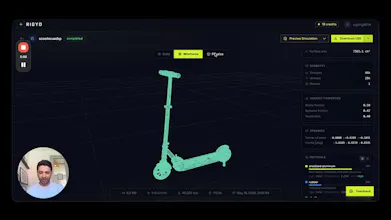
So we built Rigyd. It ingests raw 3D, images, or text and produces validated OpenUSD (with USDPhysics schemas) and MJCF, with collision meshes, mass, friction, restitution, material properties, and semantic labels baked in. Works in Isaac Sim, MuJoCo, and Unreal out of the box.
No manual annotation. Weeks → minutes. From any input.
Our early users are already using it for
→ Warehouse automation
→ Simulating surgical rooms
→ Testing robotic arms before deployment
The UI is for exploration. The real surface is programmatic. Rigyd exposes tools so agents (or your own pipelines) can generate millions of physics-accurate sims directly inside NVIDIA Isaac Sim, MuJoCo, or wherever you train.
If you're building anything in robotics, AV, industrial automation, or embodied AI: claim the free credits on signup. All we'd ask is honest feedback. What works, what doesn't, what you wish it did differently.
If you've hit the sim-data wall and want enterprise/bulk API access, DM me. We're onboarding a small group of design partners in June.
If you just want to nerd out about OpenUSD, domain randomization, or sim-to-real transfer, we're in the comments all day.
Robotics is going to be the largest industry in history. We think the data infrastructure for it should be as easy to use as Stripe is for payments. That's what we're building.
Check it out 👉 rigyd.com
Ugur
@uguryekta looks sick!
@uguryekta This is next level type ish!!
How do you validate that the physics actually behaves correctly post-generation? Do you run automated sim rollouts, compare against ground-truth measurements, or rely on schema conformance only?
@zeynep_yorulmaz we have built-in NVIDIA Omniverse asset validator in Rigyd. It checks tens of parameters from geometry to name convention. you can see it here: https://docs.rigyd.com/simready-validation/full-coverage/
Hey @zeynep_yorulmaz ! Dogancan here, R&D Lead at Rigyd. Three layers:
Every asset conforms to SimReady Foundation standards (USD/MJCF), catching structural issues at export.
Each asset runs through a headless tilting-ramp test in Isaac Sim (0°–50° over 4s) that exercises all six physics properties in behavior: mass, friction, restitution, collision, COM, and inertia. If it falls wrong, slides wrong, or clips, it fails before shipping.
We don't physically measure each object's mass or friction; instead our proprietary estimation engine infers physics properties from the asset depending on the materials and dimensions. For robot-learning workflows where domain randomization is the goal, a distribution of plausible physics is what you actually want, not one ground-truth value per object.
This is cool. Curious how are you generating collision meshes under the hood? VHACD-style decomposition, SDFs, or custom approximations?
@serefyarar We went with CoACD. It improves on V-HACD which tends to over-simplify concavity, and we can tune the collision/performance trade-off via the concavity threshold. The hulls play nicely with both Isaac Sim's PhysX and MuJoCo's convex collision pipelines, which are our targets.
Congrats on the launch! Looks great. Curious what asset formats you ingest (OBJ, FBX, GLB, STEP, USD)?
@furkan_dindar Hi Furkan! This is Damla, PM at Rigyd. Thanks for the support! 🚀
We’ve built a pretty flexible engine, we currently support .glb, .gltf, .fbx, .obj, .stl, .ply, .usd, .usda, .usdc, .usdz, and .zip files. We would love to hear what is the needed in workflows and make sure to adapt pretty quickly.
Do you randomize visuals too, or is Rigyd mainly focused on physics and geometry?
@othman_katim we do! one of our early enterprise users demanded creating different texture variations for their warehouse and we shipped it. What kind of randomization do you need?
Wow, quality of the generated assets are impressive. With all the materials and physics. 3 credits for trial is not enough though to test all the features.
@ozgungenc Thanks Özgün! Glad you like it, I've added 20 more credits to your account to test all the features :)
@sercanov Great, thanks for the extra credits
Congrats on the launch. Also love the OpenUSD angle. I believe like the ecosystem is converging around more standardized pipelines instead of every company building tooling around meshes && annotations :)
@gorkemcetin we want them to focus on solving really hard problems by standardizing their content pipelines. Thanks for the support!