Launching today

OptScale Kompressor
Twice the Savings of Headroom on Coding-Agent Traffic
2 followers
Twice the Savings of Headroom on Coding-Agent Traffic
2 followers
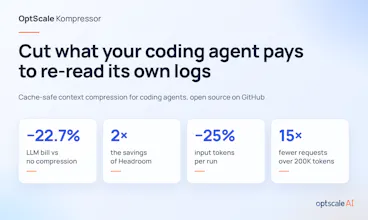
Coding agents re-send their whole history every turn, so on a long task the model re-reads the same build output dozens of times, and you pay for every read. OptScale Kompressor stops that: on Terminal-Bench 2.1 it takes 22.7% off the real bill. The same input compresses to the same bytes every turn, so the prompt cache keeps working, and every removed detail stays one retrieval away. Open source (MIT), one Rust binary, no ML model.


Hi, I’m Max, CTO at Hystax.
Coding agents re-send their entire working history to the model on every step, including build logs, compiler warnings and progress bars. On long tasks the same output is re-read dozens of times and billed each time. OptScale Kompressor removes that redundancy.
How it works:
It sits between the agent and the model provider and rewrites machine output (build logs, grep results, JSON, directory listings, source files) into a shorter form that marks exactly what was removed.
The same input always compresses to the same bytes, so the prompt cache is not invalidated.
By default keeps every removed fragment behind a handle; if the model asks for it, the proxy fetches it back on its own.
No ML model, nothing downloaded at runtime: a single Rust binary, about 0.2 ms per KB.
Results on Terminal-Bench 2.1 (Codex CLI, GPT-5.5, real provider bills with the cache discount): 22.7% lower cost, about twice Headroom’s savings, no significant change in solve rate. The largest gains are on ML training, source builds and data pipelines.
Current status: Codex is supported (kompressor wrap codex). Claude Code runs through the wrap but is not compressed, because rewriting its cached conversation would invalidate the prompt cache. Details are in the README.
MIT-licensed. Runs as a single binary or inside OptScale AI.
Questions and feedback welcome.