
OkkMax
The review and monitoring platform for AI API proxy services
10 followers
The review and monitoring platform for AI API proxy services
10 followers
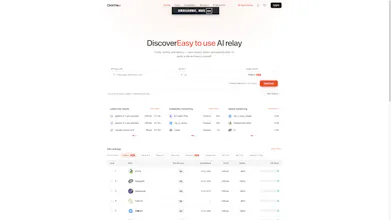
OkkMax helps developers find reliable AI API proxy services. We track model purity, uptime, latency, and real user reviews, so users can compare providers with more transparent data. Part of the project is open source to make the methodology easier to inspect and improve.


How do you actually verify the uptime and latency numbers in your tracking, and are you pulling that data from your own probes or relying on user reports?
@emirhan255440 Great question — those numbers come from our own probes, not user reports or provider-submitted data.
OkkMax runs scheduled checks against each listed provider and records timestamp, response status, latency, and availability for every probe. The uptime and latency numbers are aggregated from that monitoring history.
User reports are only an additional feedback signal. They help us spot regional or intermittent issues, but they don’t directly generate the uptime or latency score.
How do you actually verify that the model purity and uptime numbers are accurate and not just self-reported by the proxy providers themselves?
@barztalnnug Great question — those numbers are not self-reported by the providers.
For uptime and latency, OkkMax runs its own scheduled probes against the listed providers. We record the result of each check with timestamps, response status, latency, and recent availability history. Providers don’t submit those numbers themselves.
For model purity, we use cross-checking rather than relying on the provider’s claim. The system sends controlled prompts and compares behavior patterns, response characteristics, and capability signals against what we expect from the claimed model. It’s not a perfect fingerprint, and we don’t present it as 100% definitive, but it helps surface suspicious mismatches.
So the idea is: provider claims are only the starting point. The public score is based on our own monitoring signals plus transparent history, not just what a proxy provider says about itself.
We’re also working on making the methodology page more detailed so people can inspect how each signal is collected and weighted.
Checked a couple of providers I'm already using and the latency numbers matched pretty closely to what I see in practice, which is rare. The open methodology page is a nice touch too.
@hamdikayrazasr Thank you — that’s really helpful to hear.
Latency is tricky because it can vary by region, model, time of day, and provider routing, so we don’t expect our numbers to match every user perfectly. But the goal is to make them close enough to reflect real-world usage instead of showing vague or self-reported scores.
Feedback like this is useful because it helps us validate whether the monitoring data matches what users actually experience.
We’ll keep improving the methodology page and may add more region-level latency breakdowns over time.
the transparent methodology page is genuinely refreshing, especially the way uptime and latency are broken down per provider with timestamps instead of vague scores. nice to see a dev tool that actually shows its work.
@kerimkkavuggeq Thank you — that means a lot.
That was exactly the goal. I didn’t want OkkMax to become another vague ranking page where users only see a final score without knowing what happened underneath.
For uptime and latency, we try to show the raw monitoring context as much as possible: timestamps, recent checks, availability history, and provider-level changes. A score can be useful, but the underlying data is what makes it trustworthy.
We’re also working on making the methodology page more detailed over time, especially around model purity checks and how different signals affect the final ranking.
Really appreciate you noticing this.
How do you verify that the reviews are actually from real users and not just planted by the proxy providers themselves?
@sevcanm14453 Great question — this is something we’re very aware of.
We don’t treat user reviews as the only source of truth. Reviews are one signal, but they are shown together with objective monitoring data such as uptime, latency, availability history, and model purity checks.
For reviews specifically, we look at several anti-spam signals, including account behavior, repeated wording, abnormal rating patterns, and suspicious bursts from the same provider or time window. Obvious promotional or planted reviews can be removed or down-ranked.
We also plan to add stronger verification over time, such as optional proof-of-use, reviewer history, and clearer labels for provider responses.
So the goal is not to claim every review is perfectly verified from day one, but to make planted reviews much less useful by combining community feedback with measurable data.
the open source methodology piece is genuinely smart, makes the whole comparison feel trustworthy instead of just another opaque ranking site.
@zmrakl6f Thank you — that’s exactly what we were aiming for.
For a comparison product like this, trust is the hard part. If OkkMax only showed a final score, it would be just another opaque ranking site.
That’s why we decided to open-source part of the methodology and web layer, and make the monitoring signals visible instead of hiding everything behind a black box.
There’s still a lot to improve, but I think transparency is the only way this kind of platform can be useful long-term.