
Mindweave
Your AI second brain that actually remembers for you
6 followers
Your AI second brain that actually remembers for you
6 followers
You read 100 articles a week. How many can you recall? Mindweave is an AI-powered knowledge hub that makes everything you save findable, forever. Capture notes, links, and files. AI auto-tags everything and creates vector embeddings — zero manual organizing. Search by meaning, not keywords. Ask questions in natural language and get answers from your own knowledge base. Available as a web app, Chrome Extension, and Android app (beta). 100% open source (MIT). Self-host or use our cloud.




Hi Product Hunt! I'm Abhi, the maker of Mindweave.
I work in strategy and partnerships, and my job involves consuming a lot of information — articles, research papers, podcasts, meeting notes, random threads. I was drowning. Not in capturing — I had 15 apps for that. The problem was that nothing I saved ever came back when I needed it.
I'd remember reading something brilliant about pricing strategy, but couldn't find it. I'd search my bookmarks for a keyword and get nothing because I was searching for the concept, not the exact words. I started to feel like 90% of what I read was just... gone.
So I built Mindweave to solve the retrieval problem. The key insight was vector embeddings. When you save something to Mindweave, it doesn't just store the text — it creates a 768-dimensional mathematical representation of the meaning. So when you search for "how to handle difficult stakeholders," it finds that article you saved about "navigating executive resistance in cross-functional teams" — because the meaning is similar, even though the words aren't.
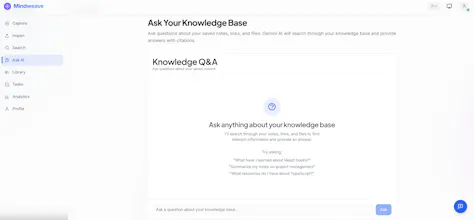
And the Q&A feature is what makes it feel like a real second brain. Instead of searching, you just ask: "What frameworks have I saved for evaluating market entry?" and it synthesizes an answer from your own knowledge base.
This is fully open source (MIT). I wanted anyone to be able to self-host their own knowledge hub without trusting a third party with their data. The codebase has 1,440+ tests and is built with Next.js 15, TypeScript, PostgreSQL with pgvector, and Google Gemini.
I'd love your feedback — what features would make this more useful for you? And if you try it out, every bug report on GitHub genuinely helps. Thanks for checking it out!