Meetstream.ai
A unified API for meeting bots.
189 followers
A unified API for meeting bots.
189 followers
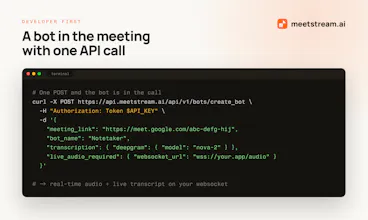
meetstream.ai is an unified API & infrastructure platform that provides a single API for meeting bots to join, record, analyze & push meeting data to CRMs, PMSs - helping your team focus on the actual AI development
This is the 2nd launch from Meetstream.ai. View more

MeetStream AI
Launching today
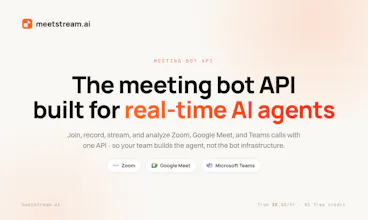
Agent-first infrastructure for meetings. One API to capture 50+ real-time data points from Zoom, Google Meet, and Teams, with built-in voice infrastructure so your agent joins as a participant, listens, speaks, and acts while the call is happening.


Free Options
Launch Team

Meetstream.ai
Hey Product Hunt! I'm @sidhdharth, co-founder of MeetStream AI.
Here's the bet we've staked the company on: meetings are about to stop being human-only rooms.
The people who own the platforms already believe it. Zoom's CEO says he wants to send a digital twin to his meetings. Microsoft is reorganizing Teams around human-agent teams. Fireflies hit a $1B valuation and gave its notetaker a voice. Gartner says 40% of enterprise apps will ship task-specific agents by the end of this year, up from under 5% last year.
But almost all of it is still capture: record the meeting, summarize it afterward. The agent reads the minutes. It never sits at the table.
So we built two things, and you need both to change that.
An unified capture engine. 50+ data points per meeting in real time: per-participant audio and video, live transcripts with speaker attribution, participant events, the full meeting lifecycle over webhooks. Zoom, Google Meet, and Teams through one API.
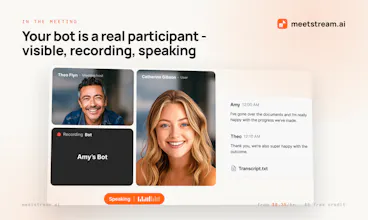
A voice infra layer. Your agent joins as a real participant with scoped permissions, speaks while the conversation is still happening, and calls tools mid-call. Ours update CRMs while the customer is still talking.
Here's what I keep coming back to: every agent company is chasing the same scarce resource, and it's context.
The context that matters most isn't sitting in a CRM field or a doc. It's in the conversation. Decisions get made in meetings. Objections surface in meetings. Most of it is never written down anywhere.
That's what we let them capture. Today MeetStream runs underneath CRM platforms, customer support tools, productivity apps, and yes, notetakers (we're not one, we power them!). 30+ AI products in production. In every one of them we ship as a feature: meeting data flowing in, and a voice going back into the room.
I didn't set out to build this either. I wanted a sales agent that could speak in meetings, and found the hard part wasn't intelligence, it was presence: lobby states, per-speaker streams, reconnection logic, platform changes that break things at 2am. Every AI team hits that wall. So we became the rails.
Voice is how humans have always worked together. Now agents are joining the conversation, literally. You build the agent. We keep it in the room.
We've been in private beta for a long time, building with a small group of teams who were patient with us while we got the hard parts right. Today we're opening it up to everyone. No waitlist, no sales call. Sign up and put a bot in a meeting in a few minutes.
What we actually want from today is the feedback. Tell us what's missing, what broke, what you'd need before you'd trust this in production. I'm reading every comment.
So, honestly: how critical do you think agents in meetings will be? I'd love to hear where you land.
@sidhdharth Congratulations on the launch! 🚀 The idea of giving AI agents actual presence in meetings instead of just summarizing them afterward is really compelling.
One question: how do you handle interruptions and turn-taking when the agent needs to speak while multiple participants are talking?
Meetstream.ai
@kamal_sharma26 Hey Kamal, thank you! We have in-build VAD systems setup that you can tweak controls with. This is exactly the layer gap as meeting platforms are multi-person. We have additional controls like Wake Up Word, Listening Window etc. that allows for deeper conversation flow control.
Meetstream.ai
@kamal_sharma26 we have such controls built in our dashboard (also configurable via API) for each voice agent you create!
Meetstream.ai
@navaneeth_jawahar here, co-founder and CTO. @sidhdharth covered the why. Let me cover how it's built, because the architecture is the actual product.
Most "voice agent in a meeting" setups today are three vendors stitched together: a meeting-bot API to get into the room, a hosted voice platform somewhere else to run the agent, and a widget or iframe injected to bridge the two. Three integrations, three billing relationships, three sets of licenses, and latency that compounds at every hop.
We built MIA (MeetStream Infrastructure Agents) so the orchestration lives inside the same platform that holds the meeting seat.
What that means concretely:
One integration surface: The bot that joins the call and the agent that speaks in it are the same system. No external voice host, no injected HTML, no separate license stack to manage.
Bring your own models: STT, LLM, and TTS are all pluggable. We orchestrate the loop; you pick the providers. Deepgram, AssemblyAI, OpenAI, Gemini, ElevenLabs, Sarvam.
Wake word or proactive: Run it pipeline-mode with a wake word ("Hey MIA"), or realtime-mode where the agent decides when to speak.
In-meeting tool calling + MCP: The agent can call functions or MCP tools mid-call and report back by voice while the meeting is still going. Your tools, our tools, MCP - your pick. Or your agent’s pick, if you trust it that much.
Now the part nobody talks about, which is where most of the engineering actually went.
Every bot is a live media workload. A machine that joins a call, holds a real-time audio and video pipeline open for the length of the meeting, separates streams per speaker, and tears down cleanly. That is not a request-response API. It is closer to running a hyperscaler: we spin up over 100,000 servers a month, and the hard requirement is that none of them fall over mid-meeting, because a dropped bot is our customer's product failing in front of their customer.
Then there is platform drift. Zoom, Google Meet, and Teams each ship SDK updates, DOM changes, auth changes, and admission-flow changes on their own schedule, usually without notice. A meeting bot is permanently downstream of three roadmaps you do not control. Absorbing that so nothing changes for the teams building on us is, honestly, most of what this company does.
The rest of the unglamorous list: per-participant audio separation, speaker attribution that survives rejoins, lobby state handling across three different admission models, and reconnection that does not drop the media pipeline.
That is the layer we maintain so you don't have to.
Happy to go deep on any of it: architecture, real-time media orchestration at scale, latency, cost optimizations, and finally: why diarization is harder than it looks. Ask away.
When i read this, it just made so much sense! There are so many agents that would benefit from joining meetings, but why should all of them and their companies spend time and money on building that infra!
With meetstream, i am not going to get October agents to join dev calls!
Meetstream.ai
@harshsaver Thank you, we should collab!