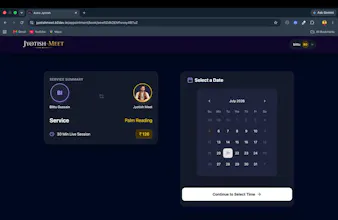
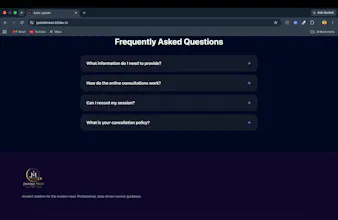
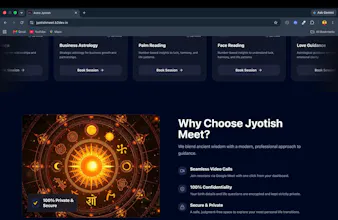
A production-ready booking platform built with Next.js & Firebase. Featuring a strict Redis atomic locking layer to eliminate race conditions. Open for community testing and real-time performance feedback!
No reviews yetBe the first to leave a review for Jyotish Meet
Maker
📌
Hey Product Hunt! 👋 I'm Bittu, the developer behind Jyotish Meet.
I built this as a battle-tested showcase of how modern web applications should handle high-concurrency traffic. Too many standard scheduling tools crash or suffer from double-booking race conditions when a creator or practitioner experiences a sudden spike in traffic.
I wanted to solve that problem deterministically using a strict Upstash Redis Atomic Lock (NX) over a Next.js and Firebase architecture.
I’m launching today specifically to get your feedback and help me stress-test the live platform:
🛠️ Try to break the checkout: I heavily integration-tested the API against 2,645 simultaneous requests using k6, resulting in zero data collisions. Go ahead and try to double-book a slot!
⚡ Experience the Edge Latency: Browse the calendar to see how the caching layer keeps page delivery under 50ms.
✨ Critique the UI: Explore the glassmorphic dark-theme interface built entirely with Tailwind CSS.
Note: The GitHub repository is currently private to protect the live Razorpay and Firebase environments, but I am an open book regarding the backend engineering!
I am completely open to architectural critique, UI layout suggestions, and performance bug reports. Drop your thoughts or questions about the Redis lock implementation in the comments below! 👇
Report
How does the Redis locking layer handle cases where a user’s session drops mid-booking? Genuinely curious if that can lead to stuck slots or if there’s a built-in TTL fallback.
Report
Maker
@mervekatn2maiGreat question! It handles it in two ways:
Built-in TTL: Every Redis lock has a strict 15-minute expiration (EX 900). If a session completely drops, the slot automatically frees itself after 15 minutes.
Instant Release: If the payment fails or the user manually closes the checkout modal, the frontend catches it and instantly calls redis.del(lockKey) to unlock the slot immediately.
Bottom line: Worst case is a 15-minute hold, but slots never get permanently stuck!
Report
Curious how the Redis locking actually holds up when two users hit the same time slot at the exact same millisecond — would love to know what happens on the edge cases.
Report
Maker
@batuhanycecjqy Great question! This exact millisecond edge case is why I chose Redis.
Because Redis is single-threaded, it processes operations sequentially—even if they arrive at the exact same millisecond.
Both requests fire an atomic SET NX command. Redis processes one first, granting the lock and letting them proceed to checkout. The second request instantly gets a nil response.
The API catches that nil and aborts the transaction before it ever touches the Firebase database, showing the second user a "Slot just taken" message. I load-tested this exact scenario with over 2,600 simultaneous requests, and it perfectly blocked all 2,599 duplicates every time!
Report
Really cool to see a booking platform with proper Redis locking baked in, that's a detail most skip and end up regretting. One thing I'd love to try is calendar sync with Google or Outlook, so bookings can show up alongside existing appointments without manual copying. Would make this feel way more plug and play for consultants already living in their calendars.
Report
Maker
@snbilek8382 Thanks so much! Yeah, building the Redis lock took some work, but it was 100% worth it to prevent double-bookings.
You read my mind on the calendar sync! Adding Google and Outlook integration is the very next feature I am building for V2 so it's fully plug-and-play. Thanks for checking it out!
How does the Redis locking layer handle cases where a user’s session drops mid-booking? Genuinely curious if that can lead to stuck slots or if there’s a built-in TTL fallback.
@mervekatn2mai Great question! It handles it in two ways:
Built-in TTL: Every Redis lock has a strict 15-minute expiration (EX 900). If a session completely drops, the slot automatically frees itself after 15 minutes.
Instant Release: If the payment fails or the user manually closes the checkout modal, the frontend catches it and instantly calls redis.del(lockKey) to unlock the slot immediately.
Bottom line: Worst case is a 15-minute hold, but slots never get permanently stuck!
Curious how the Redis locking actually holds up when two users hit the same time slot at the exact same millisecond — would love to know what happens on the edge cases.
Really cool to see a booking platform with proper Redis locking baked in, that's a detail most skip and end up regretting. One thing I'd love to try is calendar sync with Google or Outlook, so bookings can show up alongside existing appointments without manual copying. Would make this feel way more plug and play for consultants already living in their calendars.
@snbilek8382 Thanks so much! Yeah, building the Redis lock took some work, but it was 100% worth it to prevent double-bookings.
You read my mind on the calendar sync! Adding Google and Outlook integration is the very next feature I am building for V2 so it's fully plug-and-play. Thanks for checking it out!