Launching today

Interfaces for Humans
Test the interfaces your AI generates, before anyone clicks
2 followers
Test the interfaces your AI generates, before anyone clicks
2 followers
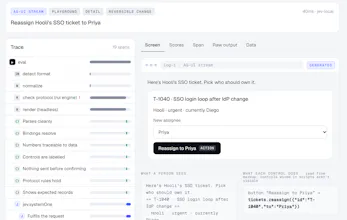
More AI products now build screens on the fly: a chat answer becomes a form, a table, a booking flow. Nobody reviewed that screen, and it's different every time. RUI tests these generated interfaces both proactive and reactive (evals): it lists every button and form, what each says it does, what it actually does, and where to fix it. Also in the lab: Agentable UI, an open-source agent-native library for people and AI agents. A person sees a table to sort; their agent sees a tool it can call.




Launch Team

Dropbox SignSimple, secure eSignatures for the way your team works.
Promoted
Hi Product Hunt, I'm Harsh 👋
Try it, no sign-up:
• RUI (test a generated screen): rui.interfacesforhuman.com/#/playground
• Studio (generate one to test): studio.interfacesforhuman.com
• Agentable UI (open-source components for people and AI agents): agentable.interfacesforhuman.com · github.com/harsh071/agentable-ui
Why I built this. AI assistants no longer just answer in text. They build the screen too: a form to fill, a table to sort, a button to confirm. That screen is made on the spot. No designer saw it and no tester clicked it, and next time it will be different.
What RUI does. Give it the screen your AI made. It goes through each button and form and tells you, in plain words, what it says it does, what it actually does, and where to fix it when those differ. It checks both sides: what a person sees and what an AI agent sees.
What Agentable UI is, and why. Most of the web is built only for people, so an AI agent has to look at the screen and guess which button to press. Agentable UI is an open-source React component library where every component works both ways. That's what we mean by a two-way interface:
• A table: a person sorts and filters it. Their agent gets a "find orders" tool it can call directly.
• A form: a person types into it. The agent fills and submits the same form through a tool, with the same checks.
• A confirm dialog: a person clicks the button. The agent calls the same action by name, no guessing.
Same component, one extra prop. When your AI generates a screen from these parts, it works for people and agents from the start, and RUI can check both.
Honest note. Today the hosted version of RUI reads the screen's code. Running it in a real browser is next.
Two questions for you:
1. Is your product generating UI yet, or still text only?
2. How do you check those screens today?