
IndexDecode
Check if AI crawlers can find, read, and cite your site
7 followers
Check if AI crawlers can find, read, and cite your site
7 followers
Free diagnostic that checks 30+ AI crawlers and 70+ Google indexing signals on any URL. See if ChatGPT, Claude, and Perplexity can actually reach your content — with platform-specific fixes for Next.js, WordPress, Shopify & more.


Hey PH! I'm Ram 👋
I built IndexDecode because I kept running into the same problem: sites that rank perfectly on Google are invisible to ChatGPT, Claude, and Perplexity.
Google executes JavaScript. Most AI crawlers don't. Google reads your sitemap. AI bots may not even check robots.txt. The rules are completely different, and there wasn't a single tool that checked both worlds together.
So I built one.
What IndexDecode does differently:
Most "AI visibility" tools ask ChatGPT "do you know this brand?" and count mentions. That's brand monitoring — useful, but different.
IndexDecode checks the TECHNICAL layer: can AI crawlers actually reach your page? Can they extract meaningful content from it? Is your content structured so AI can cite you with attribution?
That's our three-layer framework:
Access — Can AI bots technically reach your content?
Extractability — Can they understand what they find?
Citability — Can they quote and attribute it to you?
What's free (everything):
Single page scans — unlimited, no signup
30+ AI crawlers checked (GPTBot, ClaudeBot, PerplexityBot...)
70+ Google indexing checks
Platform-specific fixes (not generic — actual Next.js/WordPress code)
Export to PDF, HTML, Markdown, JSON
12 standalone tools (robots.txt checker, meta tags, redirects...)
What Pro adds:
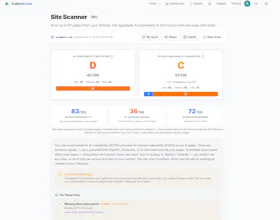
Site Scanner: scan 25+ pages from your sitemap at once
"Fix Once, Fix Everywhere" — finds template-level issues that one code change resolves across your entire site
LLM-generated action plans
Score tracking over time
I'm a senior data engineer by day, building this nights and weekends. The whole thing runs on Supabase + Lovable.
Would love your honest feedback — and if you scan your own site, share your scores in the comments. I'm genuinely curious what people find.
🔗 https://indexdecode.com
Love that this checks beyond just Google. One thing that would make this way more useful for me is a scheduled recheck option, like once a week it pings my key URLs and pings me if something falls out of the index or a crawler gets blocked. Right now I have to remember to come back, and I never do.
@abdulsamet2lqg Thanks!
Scheduled rechecks are definitely on the roadmap you're describing exactly the use case I want to nail. The idea is:
you add a URL to your watchlist, we re-scan it weekly, and you get an email only when something changes - score drops, a crawler gets blocked, Cloudflare starts challenging bots, etc. No noise, just alerts that matter. Right now you can re-scan manually from the dashboard and see the score delta vs your previous scan, but I agree - having to remember to come back defeats the purpose. That's the difference between a diagnostic tool and a monitoring system, and it's the next big step. Appreciate the feedback - it's validating to hear the same request from actual users.
A scheduled recheck would be huge — I can run the diagnostic today and see issues, but I have no easy way to know if my fixes actually worked across a week of deployments. Even a simple weekly email with a before/after score for the same URL would close the loop and make this feel like ongoing monitoring rather than a one-off snapshot.
@serpildckx Great ideas! Scan → fix → deploy → "...did it work?" → forget to check → repeat. A weekly email with before/after scores per URL is the plan I am thinking of. Something like:
"www.example.com: AI 47→62 ↑15 | Google 90→91 ↑1
✓ Fixed: semantic HTML structure
⚠ Still open: no Last-Modified header"
Short, useful, no fluff. If nothing changed, no email. Appreciate the feedback!
Ran a few of my own pages through it and the per-platform fix suggestions were surprisingly specific, not just generic "improve your robots.txt" stuff. Liked that it separates the AI crawler check from the Google indexing check, made it way easier to actually act on the results.
@bsanverdi65035 Really glad the platform-specific fixes landed well - that's the thing I spent the most time on. Generic advice like "add structured data" never helped me when I was staring at a Next.js layout.tsx, so every fix tries to tell you exactly WHERE in your stack to make the change. And yeah, separating AI crawlability from Google indexability was a deliberate decision. They look similar on the surface but the rules are totally different: Google renders JS, most AI crawlers don't. Google reads your sitemap, AI bots might not even check robots.txt before Cloudflare challenges them. Treating them as one score hides the real problems. Curious, did anything surprise you in your results?