Built two small utilities within minutes of signing up and the
annotation flow is what really sold me — you talk to the app you're
building and watch changes happen in real time, which makes iterating
feel more like a conversation than a build process.
Having it live in the dock, launch instantly, and work offline instead
of being just another web app tab is a genuinely different feel. The
idea of "software shaped around you" instead of one-size-fits-all apps
is not just marketing here — you can tell within the first few prompts.
Osaurus
Hey hey fam — time for me to jump in the maker seat!
Since January I've done nearly 200 coaching calls focused on launch positioning and product feedback for Product Hunt.
I've watched more great products die on bad copy than bad code.
And now thanks to agentic coding, non-developers like myself can finally bring their ideas to life.
The problem is — all those non-devs need to connect with their audience, and AI slop isn't going to cut it.
To stand out in a leaderboard that regularly exceeds 1000 products launched every 24 hour period, you need powerful, muscular prose that grabs the audience by the lapels and demands they pay attention.
Firstpass gives you feedback before you launch⁉️
Not "make it pop" — a real adversarial content crit.
Here's what few people realize: the same tagline lives or dies differently depending on where it appears.
Product Hunt gives you 60 characters. The Glaze Store caps at 40. The browse grid where people actually scan cuts near 33. A tagline that's perfectly legal in one place is unpublishable in another — and you find out after you've shipped.
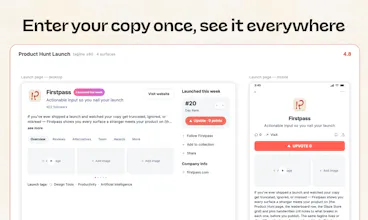
⚡ How it works: you paste your launch copy once. Firstpass renders it on every surface a stranger will actually meet it — PH page, the leaderboard row, the store grid — and pins handwritten crit notes to whatever breaks in each. It scores against a real rubric: tagline, description, gallery, maker comment, message consistency. Calibrated against 305 live listings.
🔎 Why it's different: other tools rewrite your copy. Firstpass shows you where a stranger stops reading — per surface, before you publish. It's a design crit wall, not a chatbot.
🕵🏻 The proof: I ran Firstpass on this launch. It caught that my tagline gets cut mid-word on the Glaze grid — the exact failure the app exists to find — and flagged an earlier draft of this comment for ending on two questions. It critiques itself.
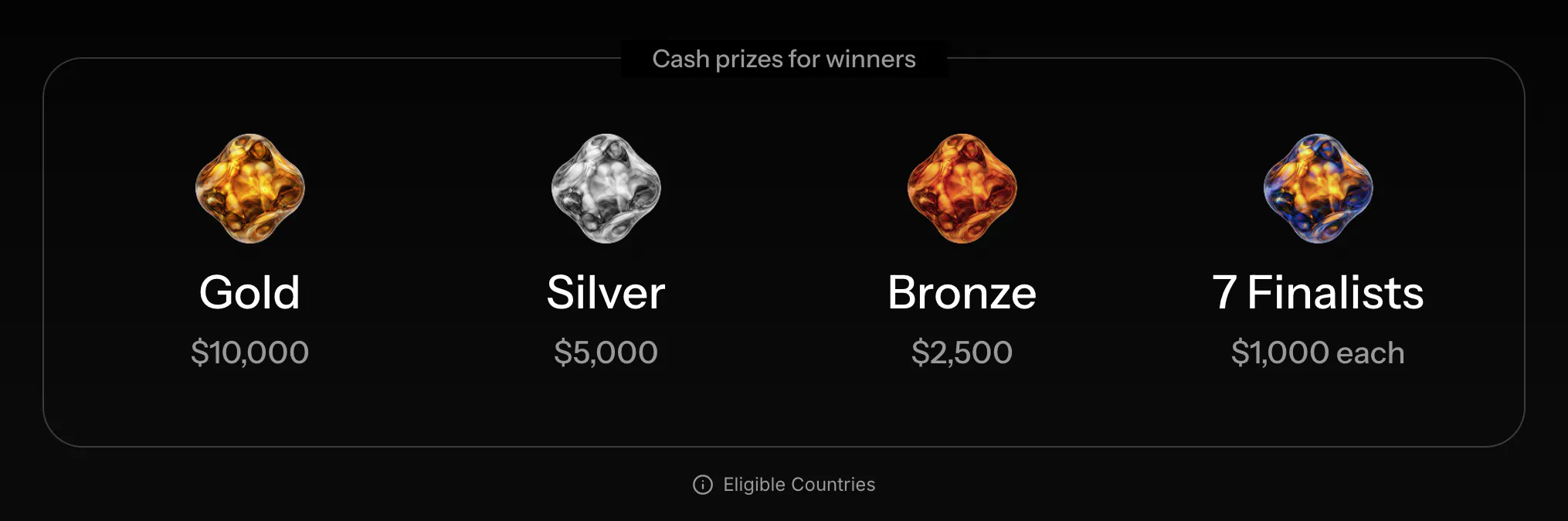
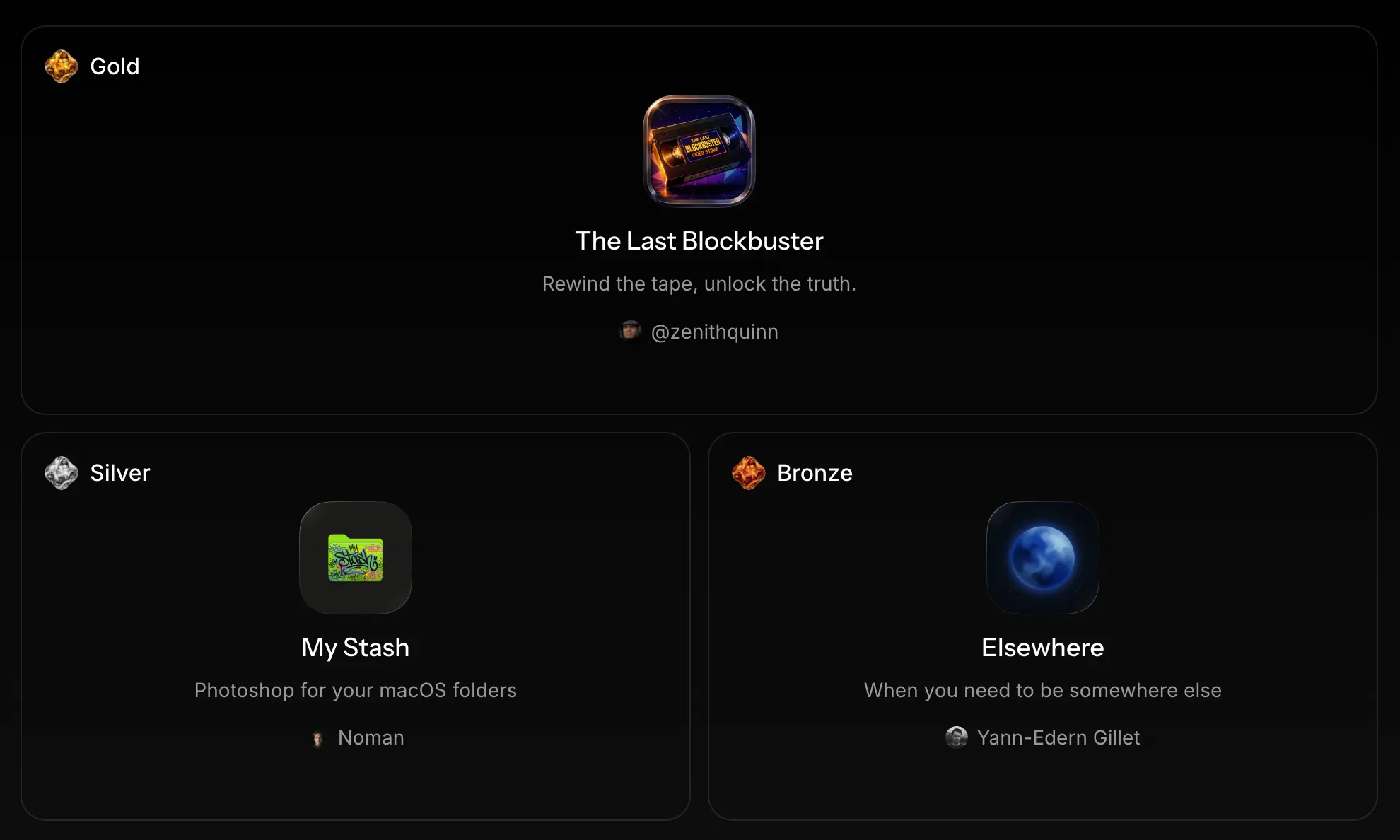
It's early — pre-beta and free while under development. If you find the concept compelling, you can get it from the Glaze store and if you like it, I'd love your support in the Glaze Awards: 🫶🏻
@chrismessina Quick question: what’s the single most common copy mistake you see that actually costs launches upvotes or attention, and can you share one tiny, practical rule we can apply right away to avoid it?
Osaurus
@swati_paliwal sure, typically there are three things I watch out for:
No clear/obvious target customer
Lacking relatable problem definition coupled with a direct pathway for how the product/solution addresses it
No description of the transformation that will result from adopting the product over time
A tiny, practical rule to follow is to start with the solution (expressed in the tagline) and only once that's sharp as a razor, bother explaining the problem.
This is usually the opposite of what AI slop machines tell you to do, but as the market fills up, ain't no one's got time to read your multi-paragraph problem narrative.
@chrismessina most of this seems calibrated around English/Latin-script copy, where character count roughly tracks how much a stranger actually has to read. does the rubric hold up for languages where that mapping breaks - CJK compresses a lot of meaning into very few characters, German tends to run long per word - or is the character-limit crit specifically an English-language tool for now?
Osaurus
@galdayan super good question. As I only focus on English-language launches on Product Hunt, similarly Firstpass is focused on that context.
Thus it's probably not useful for those other languages, unfortunately. Doesn't mean it couldn't be adapted to them, but I'm probably not the one to build that.
@chrismessina makes sense, scoping to the market you're actually launching in beats building for a language you can't validate. genuinely curious about one layer though - is the underlying insight (a stranger's attention is a fixed budget, count characters as a rough proxy for it) portable even if the exact thresholds aren't, or does the whole rubric need rebuilding per language because the failure modes are different too, not just the units. e.g. CJK slop probably isn't "too many characters," it's something else entirely that a character-count crit wouldn't even see
Osaurus
@galdayan my intuition is that different languages require different attention budgets, and some international readers probably prefer certain kinds of messages than others.
As a real world example, I've coached many Chinese teams on their Product Hunt launches — and I've had to help them rephrase or describe taglines and value props in ways that resonate with Western audiences.
The translation they came with was perfectly valid but completely off the mark.
So it's a mix of things — not to mention the taste to know what's good versus just okay.
Chris, the per-surface render is the right primitive, and I want to push on one axis the crit wall can't see by construction.
I do this dance on the App Store, where the same string holds two jobs at once. The title is a headline a human skims in a results row, and it's also an indexed retrieval field. So when a character limit forces a cut, the visible fix and the invisible cost land in different places: the tagline reads tighter and cleaner, and you've quietly dropped the word you were ranking on. Nothing on the rendered surface tells you that happened. You find out weeks later in the impressions, if you go looking.
Product Hunt is friendlier here because the leaderboard row is mostly a reading surface. It isn't purely one though. There's search, there are topic pages, and there's whatever the models are ingesting now when somebody asks them for "tools like X".
So: does the rubric have any notion of a term that has to survive, or is it scored entirely on where a stranger stops reading? A crit that says "this cut reads better and costs you the only word anyone searches for" is a note I've never gotten from any tool, and I've had to run that check by hand every time.
Osaurus
@narek_keshishyan great call out, and one that I don't have a perfect answer to!
Another way to phrase your point is that there are two audiences of product metadata: human readers and robot indexers.
Firstpass currently (given its initial focus on Product Hunt launches) prioritizes human readers scrolling through the leaderboard, where you might be up against 20-30 competitors and need to stand out.
Longer term, or in other contexts like the App Store, or in Google results, it might be more important to over-index on SEO/AEO terms or phrases that can actually turn off or annoy humans.
Finding a balance between both is an unsettled science, and may never be.
But it's something I'll consider for Firstpass — especially since Product Hunt itself is prioritizing AEO performance more these days!
The useful part for me is that it shows where a stranger stops reading instead of rewriting the copy for you. One question: when a crit note flags a break, does it explain the principle behind it so it carries to the next launch, or is it scoped to that one listing?
Osaurus
@alieksia great question.
The intention is to identify a principle when content misses the mark (so you can address the underlying concern), but if it's just a matter of truncation, that's less a principle and more a pragmatic consideration meant to help you see how listings might harm your presentation.
Reading copy where it actually renders instead of where you wrote it is the whole trick, and it generalizes past launches. Last week I ran a copy and alignment pass on my agency site and every fix that mattered came from checking each string on the rendered page, the mega menu and the footer both read fine in the file and wrong in the browser. Out of the 305 live listings you calibrated the rubric against, which surface kills the most taglines? My money is on the 33 character browse grid, since nobody writes for a surface they cannot see in the editor.
Osaurus
@abdullah_javaid3 I re-ran the rubric against the total 500+ launches...! I imagine that the most important surfaces are defined by the funnel — so wherever the most number of people are likely to see your copy.
On Product Hunt, that's the leaderboard; for Glaze, that's probably the store homepage, where you really only get 40 (!!) characters:
Launching today myself, sitting at 3 points, so your timing is either perfect or cruel.
The feedback I actually needed came earlier than launch day. Our tagline went through four versions and the one we shipped came from cutting it to fit the 60 character limit, not from anyone telling me the earlier ones were weak. That forced edit did feedback's job by accident.
Does it work on a pre-launch draft, or only once the page is live?
Osaurus
@supplymo this is definitely meant to be used before launch — to make sure that your copy looks good and reads well in the various contexts where it'll appear.
You could still use it on launch day to see if you can squeeze any more clarity in.
I see that you went with "12 free tools to check a China supplier before you pay". Here's the Firstpass analysis:
@chrismessina The message conflict one landed. It's not even a positioning choice, it's just sloppiness: I'm the founder, and there's a QC and sourcing team in Yiwu who run the checks these tools automate. Both true, but I never said how they relate, so the copy just wobbles between I and we.
Fixing that on the site too, not only here. The tagline point is fair as well. Leading with the count was me solving for the 60 character limit instead of solving for the reader.
Thanks for running it, genuinely useful.
Julep AI
Osaurus
@ishita_jindal2 oh! If you download Glaze, search in the store for Firstpass, and open its page, you should see an upvote button, like here:
Julep AI
Osaurus
@ishita_jindal2 only Glaze and Product Hunt, but I will be adding more!
I'm a little worried that X is harder to optimize for, since it now supports such long posts and is an art unto itself!
Firstpass is better for launches where you have fixed metadata or content fields, like the Chrome Web Store or the App Store, etc.