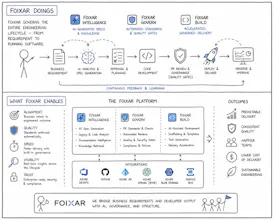
Foixar is an AI-governed software delivery platform built for enterprise engineering teams. It helps organizations move from a business brief to better software by consolidating requirements, planning, code generation, pull request governance, and delivery visibility into a single structured workflow.
No reviews yetBe the first to leave a review for Foixar
Maker
📌
Foixar was inspired by a pattern I kept seeing inside enterprise engineering teams: the hardest part of shipping software was no longer writing code; it was keeping business intent, architecture standards, implementation, and governance aligned as work moved from idea to pull request.
Teams had documents, backlog tools, AI coding assistants, architecture rules, PR reviews, audit requirements, and tribal knowledge, but they were all disconnected. On the ground, AI could generate code, but enterprises still needed confidence: Was this built from the right requirement? Did it follow our architecture? Can we explain why a decision was made six months later? Can we prove the AI did not become an ungoverned black box?
That is the problem Foixar solves.
Foixar turns the delivery lifecycle into a governed system: business context becomes structured specs, specs become implementation plans, code changes are reviewed by specialist agents, architectural decisions are captured into memory, and every governance result is auditable. Customers bring their own cloud resources and LLMs, while Foixar provides the orchestration, agents, rules, audit trails, and delivery intelligence.
Our approach evolved a lot during launch preparation. At first, Foixar looked like an AI-assisted delivery platform. As we worked through real enterprise readiness, it became clear the deeper product was governed software delivery. That shifted our focus from “generate specs and code” to “make every AI-assisted step explainable, configurable, tenant-isolated, and auditable.”
That evolution shaped major parts of the launch: BYO model and storage, multi-agent governance, decision memory, GitHub and Azure DevOps support, rule management, trial onboarding, and production readiness. The product became less about replacing engineers and more about giving engineering teams a control system for AI-assisted delivery.