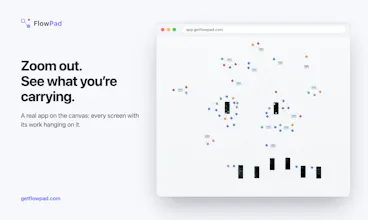
Your design and your tasks stop living in two tools. Sketch three versions of a screen on an infinite canvas, pick one, and it becomes the plan: tasks, bugs and features hang on the thing they are about, not in a tracker where the link only exists in your head. Ask the built-in AI to draw a screen, split it into tasks, or answer "what is blocking launch". Coding agents read and write the same canvas over MCP. Jira shows what's left to do. FlowPad shows what you're carrying.
I created this app because, as a solo developer and while working at small and mid-size companies, I kept noticing the same patterns and the same repeated problems. I was always jumping between Figma and Jira, and the PM, the designer and the dev were each looking at a different tool. But the biggest one was bugs: in a tracker, a bug is a row in a list, and after two sprints it scrolls away into the past. I wanted bugs to live on a 2D canvas, pinned on the screen they belong to. A bug should be visual clutter. That is a good thing: you cannot ignore what is sitting on top of your design. And I imagined this product would fit nicely into the new AI development era.
It's basically Figma and Jira, merged on one canvas. You can design and create tasks in the same moment. Inside the app there is a rich AI called Flo. But I also give developers and PMs an MCP tool, which is like Cursor but for designing. I really focused on this feature. I published the engine of Flowpad as a public npm package, so the MCP can use it as a local project. As a developer, I spent a lot of my time on optimizing token usage. You can see how it works in the examples and videos.
My next planned product will be Flowpad with VS Code embedded, so it will really be like Cursor. I have not decided yet if it should be an extension or a whole product. I decide slowly.
Dogfooding was successful for me: I liked my own product. I hope other people will like it too. I would love to hear what you think, especially the harsh parts.