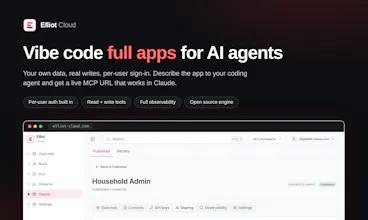
Most MCP servers just wrap an existing API, read-only, without designing a real product for agents. Elliot treats the agent as the end user and bakes in what that actually requires: results sized for the context window, errors an agent can recover from, and full app that agents stick to Connect your data or create it inside Elliot, add read and write tools, and publish to a live MCP URL any assistant can use. Every call is observable token cost, latency, errors, which tools agents struggle with
Hi Product Hunt! I've built a lot of MCP servers, and I kept hitting the same wall: most of them are thin wrappers around someone else's API. Read-only, token-hungry, errors agents can't recover from, and zero visibility into what the agent actually did with your tools.
So I built one platform that bakes in the best practices I kept re-implementing by hand: tool descriptions that read like contracts, results sized for context windows, errors that tell the agent what to do next, and observability on every call. Token cost, latency, error rate, and which tools agents struggle with, per tool.
Then I took it further. Agents don't just need better wrappers, they need real apps: their own data, write access, and per-user accounts. My wife and I wanted an AI assistant that could run our family paperwork, forms, renewals, deadlines. I described the app to my coding agent, Elliot built it, and now we each sign in through Claude and ChatGPT We use it every day.
Building agentic apps this early is also how I learn how agents actually behave with real tools, and that feedback goes straight back into the platform.
This is an experimental MVP The engine is fully open source. Ask me anything!
Report
Reviews
No reviews yetBe the first to leave a review for Elliot Cloud



Hi Product Hunt! I've built a lot of MCP servers, and I kept hitting the same wall: most of them are thin wrappers around someone else's API. Read-only, token-hungry, errors agents can't recover from, and zero visibility into what the agent actually did with your tools.
So I built one platform that bakes in the best practices I kept re-implementing by hand: tool descriptions that read like contracts, results sized for context windows, errors that tell the agent what to do next, and observability on every call. Token cost, latency, error rate, and which tools agents struggle with, per tool.
Then I took it further. Agents don't just need better wrappers, they need real apps: their own data, write access, and per-user accounts. My wife and I wanted an AI assistant that could run our family paperwork, forms, renewals, deadlines. I described the app to my coding agent, Elliot built it, and now we each sign in through Claude and ChatGPT We use it every day.
Building agentic apps this early is also how I learn how agents actually behave with real tools, and that feedback goes straight back into the platform.
This is an experimental MVP
The engine is fully open source. Ask me anything!