
DocuTruth
Catch fabricated citations before they wreck your reputation
12 followers
Catch fabricated citations before they wreck your reputation
12 followers
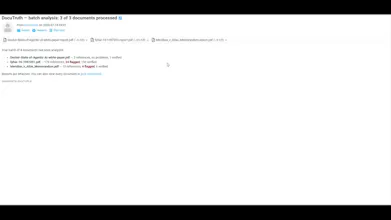
Upload a brief or paper. DocuTruth verifies every citation against real court records and journals (CourtListener, arXiv, CrossRef, OpenAlex), flags fabricated ones first — and runs on our own model, so documents never touch a third-party AI. 5 docs/month free.


Ran a messy draft of mine through it and was surprised how fast it flagged a couple of citations I had half-remembered and never actually verified. Privacy angle is a nice touch too.
@adrian_lombard Thanks Adrian — and that's exactly the case that keeps me up at night: not the citation you know is wrong, but the half-remembered one you never got around to checking. Those are the ones that sail into a filing. Genuinely glad it caught yours. (And the privacy piece isn't a bolt-on — the whole thing runs on our own model precisely so drafts like that never leave your side.)
Honestly the fabrication flagging is the part that sold me, but it would be really helpful if you could also show a side-by-side of the original cited text versus what the court record actually says. Right now I trust the flag but I still have to go verify it myself, which kind of defeats the purpose. Would love that kind of inline diff view.
@easton_dai This is a great callout, and you've put your finger on exactly the right next layer of depth. Right now we verify at the existence level — does this case exist, is the citation accurate — and flag what doesn't hold up. What you're describing is quote-level verification: pull the actual court-record text and show, inline, that the language you quoted doesn't match what the opinion says. You're right that a lot of the real risk lives there — a citation can point to a real case and still misquote it.
Honest status: we don't do the side-by-side diff yet, but it's genuinely where I want to take this — and it's feasible for the legal lane specifically because CourtListener gives us the full opinion text, so we already have the "ground truth" side of the diff; it's the alignment + UI layer that's the work. I'd love to keep you posted when it lands.
One question, since you clearly do this for real: would you want it at the quote level (this exact passage vs. the record) or the holding level (does the case actually stand for what you cited it for)? Those are two different builds and I'm trying to figure out which one matters more to people in the work.
One question I already get a lot, so I'll answer it up front: with Claude and GPT this good, why not just paste your brief into one and ask it to check the citations?
Honest answer: asking an LLM "are these citations real?" is the exact thing that got those lawyers sanctioned in the first place. The model that will confidently invent a citation will just as confidently tell you it's real — it has no ground truth either way, it's pattern-matching in both directions.
DocuTruth doesn't ask a model for an opinion. It looks each citation up in the actual source of record — real court databases (CourtListener) for case law, arXiv/CrossRef/OpenAlex for scholarly refs. A citation only "verifies" if it resolves in a real corpus, not if a model finds it plausible.
A few things that fall out of that a prompt can't give you:
• It checks opposing counsel's citations too — not just the doc you wrote and could eyeball
• Real cases missing from one database don't get false-flagged, because we cross-check two independent sources
• You get an auditable report to hand a partner — "I verified these," with receipts
• It runs on our own self-hosted model, so privileged documents never go to a third-party API
Could a very technical lawyer wire some of this together themselves? A few do. But the gap between "ask Claude if it looks right" and "verify against the record" is exactly where the sanctions keep happening — happy to answer anything else.