
DockCV
Build, version and track your CVs in files you own
2 followers
Build, version and track your CVs in files you own
2 followers
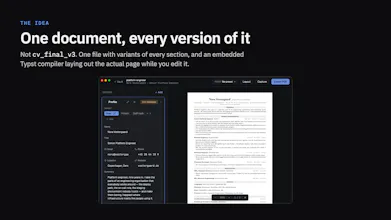
DockCV is a native, local-first CV workbench. Every section can hold several variants, presets switch between them, and an embedded Typst compiler renders the real page as you type. No account, no cloud, just a folder of plain TOML files you own.




Hey Product Hunt 👋,
Software for routine things has got greedy. A CV is a text document with dates in it, and every editor still wants my email, an account, and a card on file just in case. The good free ones solve that and then keep your work history in a database on somebody's server. The usual reply is "so use Google Docs". Fair, except they carry the same weight from the other end, and neither of them has ever stopped anyone from producing cv_for_company_v3.docx.
I built something with a different shape. DockCV is a native desktop app, written in Rust on GPUI, with no Electron and no web view, and the Typst typesetter is compiled into it. Every section can hold several versions, and a preset is nothing but a named set of those choices, so going from "FAANG | concise" to "Startup | long" is one menu away. That is the _v3 folder, solved properly.
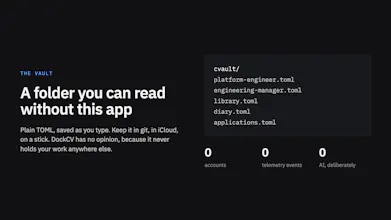
It also keeps the parts a CV editor usually forgets. A diary, so wins get written down in June instead of remembered in March. An applications board (with insights!) that stores the PDF you actually sent, so a card you open in November shows what the company read in July. Your vault is an ordinary folder of plain TOML files.
No account, no payment, no telemetry, no sync, nothing leaving your machine.
Free and open source.
I'd like to hear what breaks and what is missing.