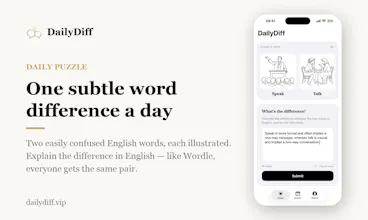
Every day: one pair of easily confused English words (Soldier vs Warrior), each illustrated. Describe the difference in English, get five-dimension AI feedback like a personal tutor, reveal the model answer, keep your streak, and share a spoiler-free card.
No reviews yetBe the first to leave a review for DailyDiff
Maker
📌
Hi Product Hunt! 👋 Solo developer here.
As a non-native English speaker, I always knew what soldier and warrior meant — but when a friend asked me to explain the difference in English, I completely blanked. That gap between "recognizing a word" and "commanding its nuance" is what DailyDiff attacks.
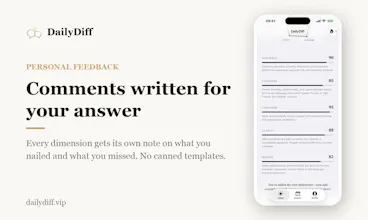
How it works: every day, everyone gets the same pair of easily confused words, each with a black-and-white line illustration. You write the difference in English, and an AI grades you across five dimensions — accuracy, coverage, language, clarity, insight — each with a comment written for your answer, like a tutor marking your work. Then the model answer is revealed, you keep your streak, and you can share a Wordle-style card that never spoils the answer.
Free & paid: today's puzzle is always free — you can try it without creating an account (1 AI scoring/day anonymous, 2 signed in). Pro unlocks the 200-puzzle back catalog, a study mode, and 15 scorings a day.
A few fun build notes: all 400 illustrations are AI-generated line art; scoring runs on Cloudflare Workers with the rubric kept server-side; anonymous scoring is protected by Apple's App Attest instead of forced sign-ups.
I'd love your feedback — especially on the scoring quality and what would keep you coming back daily. I read and answer everything. 🙏
Report
How does the five-dimension feedback actually work under the hood, especially for nuanced pairs where native speakers themselves disagree on usage? Curious whether the AI draws from a fixed rubric or adapts over time based on what gets upvoted in the shared cards.
Report
Maker
@sleymantapekwt Sorry for slow reply. Great question! Right now it's a fixed rubric — five dimensions (accuracy, coverage, language, clarity, insight), each scored 0-100 by the model, then we recompute the total/grade ourselves rather than trusting the LLM's math. For genuinely disputed usage, we lean on the rubric's model being calibrated per-pair rather than one-size-fits-all. No community-upvote-based adaptation yet, but that's an interesting direction — logging it as a possible future signal. Thanks for digging into the mechanics!
Report
It would be great if you could add a spaced repetition mode that pulls back words you missed or struggled with on previous days. Combining the daily streak habit with actual retention feels like the missing piece for turning this into a real learning tool rather than just a fun daily ritual.
Report
Maker
@abdulkadirsosn Totally agree — that's a natural next step for us. Today, Pro users can already revisit any past puzzle and re-submit a new answer anytime (great for polishing the same pair until it really clicks), but a dedicated "review your misses" mode that proactively resurfaces the words you struggled with would take it further and turn the daily streak habit into real retention. Adding it to the roadmap — thanks for the idea!
How does the five-dimension feedback actually work under the hood, especially for nuanced pairs where native speakers themselves disagree on usage? Curious whether the AI draws from a fixed rubric or adapts over time based on what gets upvoted in the shared cards.
@sleymantapekwt Sorry for slow reply.
Great question! Right now it's a fixed rubric — five dimensions (accuracy, coverage, language, clarity, insight), each scored 0-100 by the model, then we recompute the total/grade ourselves rather than trusting the LLM's math. For genuinely disputed usage, we lean on the rubric's model being calibrated per-pair rather than one-size-fits-all. No community-upvote-based adaptation yet, but that's an interesting direction — logging it as a possible future signal. Thanks for digging into the mechanics!
It would be great if you could add a spaced repetition mode that pulls back words you missed or struggled with on previous days. Combining the daily streak habit with actual retention feels like the missing piece for turning this into a real learning tool rather than just a fun daily ritual.
@abdulkadirsosn Totally agree — that's a natural next step for us. Today, Pro users can already revisit any past puzzle and re-submit a new answer anytime (great for polishing the same pair until it really clicks), but a dedicated "review your misses" mode that proactively resurfaces the words you struggled with would take it further and turn the daily streak habit into real retention. Adding it to the roadmap — thanks for the idea!