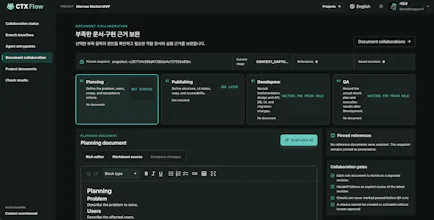
Still rebuilding context whenever work moves from planning to development or QA? CTX Flow turns project decisions into shared, versioned context that role-based AI agents can carry forward. Connect Git, pin an immutable Snapshot, collaborate through role-specific documents, and publish only human-approved context back to the repository. Agents prepare and execute. People review the evidence, approve Releases, and stay in control.
No reviews yetBe the first to leave a review for CTX Flow
Maker
📌
Hi Product Hunt — I’m DongGyun, the founder of Styxis and the creator of CTX Flow.
Have you ever opened an AI coding tool and realized that, before it can help, you have to explain the entire project again?
Or watched important context disappear as work moved from planning to development and then to QA?
We are not short of powerful AI tools. What is still missing is a usable way to work with them.
Project intent lives in one document. Product decisions live in another. Technical constraints are buried in Git, tickets, chat messages, and people’s memories. Each AI agent sees only a fragment, so every new task begins with another prompt, another explanation, and another attempt to reconstruct what the team has already decided.
That is not a model problem. It is a context UX problem.
At Styxis, I built CTX Flow around a simple idea: project context should move with the work.
CTX Flow connects to a Git repository and pins the source to an immutable Context Snapshot. Planning, Publishing, Development, and QA then work through separate, versioned documents while carrying the same project baseline forward.
Claude and Codex can help prepare role-specific drafts, but generated text does not automatically become project truth. People compare it, edit it, and explicitly save a revision. Only human-approved revisions can become a Release, and publishing that Release back to Git requires a separate approval.
The resulting Agent Context Packages give developers and AI agents a shared, traceable baseline inside the repository. When implementation and verification run, the results return as evidence linked to the relevant Snapshot, Release, and commit.
An important design principle is that agents should not certify themselves.
AI can prepare documents, implement work, and run checks. It cannot impersonate a human approver, mark an unexecuted check as passed, activate a Release, or silently publish new context to Git.
Agents prepare and execute. People decide from evidence.
CTX Flow originally began as a way to connect change requests with their verification results. As I worked on the problem, I realized that the deeper failure happened earlier: teams had no durable mechanism for carrying intent and decisions across roles, tools, and agents.
The product evolved from tracking individual changes into a Git-native context and collaboration layer for human-governed AI development.
You can explore the actual, read-only product workflows here:
https://ctxflow.cloud/en/tours
I would especially like to hear from teams already using multiple AI tools:
Where does your AI collaboration break first — context, handoffs, review, or trust?
Thank you for taking a look.
— DongGyun
Founder, Styxis
Creator of CTX Flow