Launching today

CryptPix–Cryptographic & Steganographic
AES-256-GCM+HMAC-SHA-256+Argon2id+Synch-HILL+STC+Viterbi
2 followers
AES-256-GCM+HMAC-SHA-256+Argon2id+Synch-HILL+STC+Viterbi
2 followers
■ Key Generation > Argon2id • Protects the master password and generates a secure, anti-brute-force key. ■ Encryption > AES-256-GCMHMAC-SHA-256 • It makes the message unreadable and guarantees its absolute integrity. ■ Image Analysis > Synch-HILL • Find the best spots in the image to hide data without being detected. ■ Optimization > STC+Viterbi • Reduces the number of pixels to be modified to a mathematical minimum.
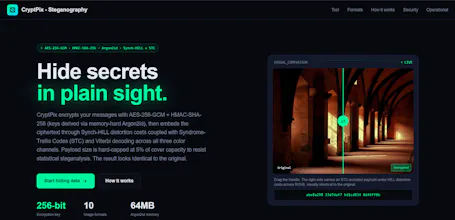


CryptPix – Steganography (AES-256-GCM + HMAC-SHA-256 + Argon2id + Synch-HILL + Syndrome-Trellis Codes + Viterbi)
The combination of these algorithms and techniques represents a highly secure cryptographic and steganographic solution for protecting and hiding information, making it resistant to both decryption and detection via steganalysis. In short, this is the state of the art of modern academic steganography in the space domain.
Try it (WebApp): https://sh3lly.byethost11.com/cryptpix
Technical Report: https://github.com/AoiAsahina/CryptPix/blob/main/CryptPix.pdf
Core Architecture & Workflow
Phase
Component
Main Purpose
Key Generation
Argon2id
Protects the master password and generates a secure, anti-brute-force key.
Encryption
AES-256-GCM + HMAC-SHA-256
It makes the message unreadable and guarantees its absolute integrity.
Image Analysis
Synch-HILL
Find the best spots in the image to hide data without being detected.
Optimization
Syndrome-Trellis Codes + Viterbi
Reduces the number of pixels to be modified to a mathematical minimum.
1. Encryption and Data Protection
This suite ensures that the message is unreadable to anyone without the key (confidentiality) and cannot be altered (integrity). Everything is processed locally using no custom cryptography libraries and no telemetry.
• AES-256-GCM: It is the gold standard for symmetric encryption. It uses an extremely secure 256-bit key in GCM (Galois/Counter Mode). This mode provides authenticated encryption (AEAD), which means it simultaneously protects both the confidentiality and integrity of the data by detecting any attempt to tamper with the ciphertext.
• HMAC-SHA-256: It is a hash-based message authentication cipher. While AES-GCM already provides internal authentication, adding an external HMAC-SHA-256 (often using the Encrypt-then-MAC approach) adds an additional, redundant layer of integrity verification, ensuring that the file has not been modified before decryption is even attempted.
• Argon2id: It is the winner of the Password Hashing Competition and is the most secure key derivation function (KDF) available today. It is used to transform a user-entered text password into the 256-bit cryptographic key required for AES. The id variant combines resistance to GPU/hardware-based attacks (thanks to its intensive use of memory) with protection against side-channel attacks (timing attacks).
2. Adaptive Steganography (Data Hiding)
Once encrypted, the file is "hidden" within a cover image using advanced techniques that minimize statistical anomalies.
• Synch-HILL (Synchronized High-Pass Low-Pass): It is one of the most advanced spatial steganography algorithms (for images like PNG or BMP) and resistant to modern steganalysis. HILL analyzes the image content and assigns an "edit cost" to each pixel. Editing pixels in uniform areas (like a blue sky) is costly because it would be noticeable; editing them in highly textured areas (like grass or hair) is very costly. The Synch version synchronizes edits across color channels (e.g., RGB) to avoid breaking natural color correlations, making the insertion invisible to statistical analyzers.
3. Channel Coding and Bit Insertion
This part optimizes the way encrypted bits are physically inserted into image pixels to minimize visual and statistical impact.
• STC (Syndrome-Trellis Codes): This is the fundamental technology for "distortion minimization" steganography. Instead of brutally overwriting the least significant bits (LSB), STC codes allow the message to be inserted by modifying as few pixels as possible, choosing only those that the HILL algorithm has dubbed "low-cost." This drastically reduces the footprint left by the hidden file.
• Viterbi: The Viterbi algorithm is the mathematical algorithm (based on dynamic programming) used within STC codes to find the optimal path through the "trellis" (the lattice of states). Simply put, it's the "engine" that calculates exactly which pixels to modify to hide information while causing the least statistical damage to the image.
// Alternative Methodology
If you prefer an approach other than steganography (which involves hiding the very existence of a message), the primary and most secure alternative is cryptography (especially post-quantum cryptography), which instead aims to make the message completely unintelligible to anyone other than the authorized recipient.
Try it (WebApp): https://sh3lly.byethost11.com/0x8
Technical Report: https://github.com/AoiAsahina/0x8/blob/main/0x8.pdf