
CommentIQ
Understand what your YouTube audience really think
10 followers
Understand what your YouTube audience really think
10 followers
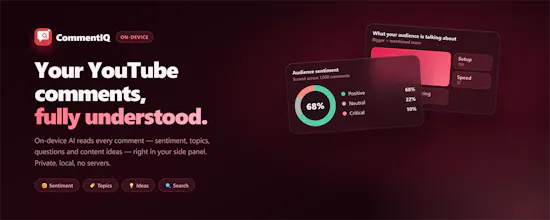
CommentIQ analyzes YouTube comments with on-device AI — sentiment breakdown, topic extraction, audience questions, and content ideas. Powered by Gemini Nano. Nothing leaves your browser. Free to install, no account required.


Free
Launch Team

Context.devAPI to scrape anything for AI, 20,000+ developers trust us.
Promoted
How accurate is the sentiment analysis on sarcastic or heavily slangy YouTube comments, and does it handle multilingual audiences well since Gemini Nano runs locally?
Hi @melahat61212 Thanks for showing interest and a great question!! I'll try to explain in detail,
Sarcasm: The hardest case for any sentiment model, and on-device Gemini Nano is no exception. Obvious sarcasm usually gets caught because the model picks up tone from surrounding comments. Subtle or deadpan sarcasm can misclassify. We lean into this limitation: sentiment is shown as a distribution across all comments, so one misread doesn't skew the whole reading. Slang actually performs better than you'd expect — "this slaps" or "mid af" lands in the right bucket.
Multilingual: Gemini Nano has multilingual capability baked into the model weights — Spanish, French, Portuguese, German, Hindi and a few others work reasonably well with no translation step needed. It degrades on less common languages and mixed-language comments (Hinglish, Spanglish etc.). Topic clustering holds up better than sentiment scoring for non-English content, since clustering groups similar ideas rather than reading emotional tone precisely.
The local-only constraint is a feature from a privacy standpoint — comment data never routes through any external service. The tradeoff is accuracy, in bounded by what fits in a small on-device model rather than a larger cloud one. Worthwhile trade for most use cases, less so if your audience is primarily a language Gemini Nano handles poorly.
Runs entirely in the browser is a nice touch, especially for creators worried about privacy. The topic extraction actually surfaced comments I had missed in the noise, which was a pleasant surprise.
Hi @nurtenztelwxgi Thanks for the feedback!!
That's exactly the use case we built it for — the signal-to-noise problem in large comment sections is real, and scrolling through 2000 comments to find the 12 genuinely useful ones is painful. Glad the topic extraction is earning its keep.
The privacy angle was non-negotiable for us from the start. Creators share a lot in comment sections — personal reactions, location hints, age, opinions — and routing all of that through a remote API to get analysis felt wrong. On-device was the only model we were comfortable with.
If you notice topics that should be clustering together but aren't, or ones that seem off, let us know — that's the part of the model we're most actively tuning.
P.S: You may have noticed that the current comments are limited to 1K. We are in the process of getting a quota increase from Youtube post which we will be able scan and analyse more comments.