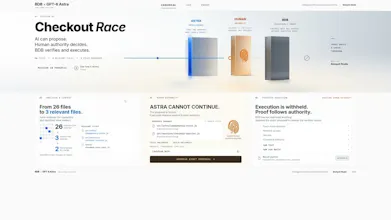
GPT-6 Astra analyzes a bounded synthetic repository, finds a genuine concurrency defect, and proposes an exact two-file fix — but it cannot execute it. A human approves one SHA-256 fingerprint. BDB then verifies the approved bytes, materializes only that change, and runs fixed test + build checks in an isolated container with no network or secrets. The result is published as sanitized, inspectable proof.
What became possible in your product with Astra that was not practical before?
Maker
GPT-6 Astra made it practical to separate high-capability software reasoning from execution authority.
In BDB, Astra can reason across a bounded repository, identify the small set of files carrying the evidence, and return exact multi-file replacements rather than a vague suggestion or patch idea.
That proposal can then be frozen, fingerprinted with SHA-256, and handed to a completely separate authority chain: a human approves the exact proposal, and BDB verifies and executes only those approved bytes.
The important change is not simply that the model can write code. Astra is capable enough to produce a precise, repository-level proposal that can become a verifiable object in a controlled execution system — without ever receiving execution authority itself.
Report
Maker
📌
We built BDB × GPT-6 Astra around a simple question:
As AI becomes more capable at changing software, should the ability to propose a change automatically include the authority to execute it?
Our answer is no.
In this Challenge Edition, GPT-6 Astra reasons across a bounded synthetic repository, finds a genuine concurrency defect, and proposes exact source-file replacements. The proposal is frozen and fingerprinted before anything can happen.
Then Astra stops.
A human must explicitly approve that exact fingerprint. Only after approval does BDB verify that the approved bytes actually landed, derive the changed set from disk, and run fixed validation commands inside an isolated container with no network and no secrets.
One of the most important parts of building this was refusing to show proof we did not actually have. When an earlier historical run lacked explicit persisted approval and materialization evidence, we treated that as unverified rather than filling in the gaps. We then created a new canonical revalidation with the missing evidence recorded correctly.
The result is the model we wanted to demonstrate:
Astra proposes.
Humans approve.
BDB proves.
You can explore the canonical walkthrough, run the live flow, and inspect the evidence directly in the product.