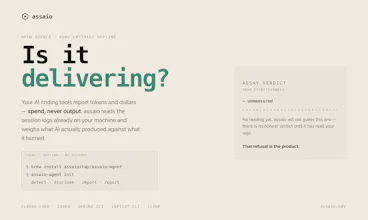
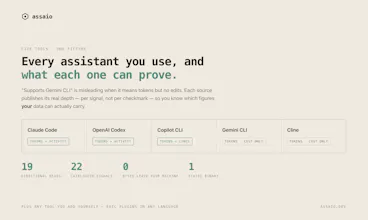
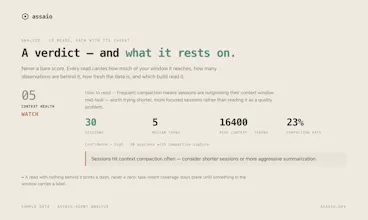
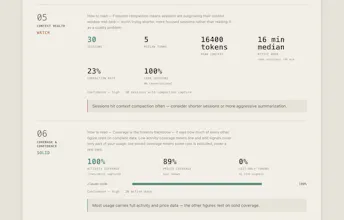
assaio turns the AI coding session logs already on your machine into honest engineering analytics: adoption, tokens, model mix, estimated cost, AI output, friction, and project-level effectiveness. It supports Claude Code, Codex CLI, Gemini CLI, GitHub Copilot CLI, and Cline. Fully offline by default - no account, no telemetry, prompts and code are never read. Open source, extensible, and self-hostable for teams.
No reviews yetBe the first to leave a review for assaio
Maker
📌
Hey Product Hunt 👋
I’m Konrad, the maker of assaio.
assaio actually started from a pretty selfish question:
Am I really using AI well?
I use AI coding tools every day, and at some point I realized I had very little idea whether I was actually getting better at it.
Was I prompting effectively?
Was I using the right model for the right kind of work?
Where was I wasting tokens or getting stuck in loops?
Was AI helping me ship more — or was it just making me feel faster?
And then the same questions started coming up at the team level.
We were paying for multiple AI tools and subscriptions, but I wanted to understand more than just whether people were using them. I wanted to know how AI was affecting the way we actually deliver software: where it helps, where it creates friction, which workflows work best, and what we could improve as a team.
I couldn’t find a tool that gave me the kind of cross-tool, privacy-friendly view I wanted, so I started building one for myself and our team.
That became assaio.
assaio reads the AI coding session logs already stored on your machine and turns them into engineering analytics — without collecting your prompts or source code.
Today it supports:
• Claude Code
• OpenAI Codex CLI
• Gemini CLI
• GitHub Copilot CLI
• Cline
It can help you understand things like:
📊 how you actually use AI across tools, projects and models
💸 where your tokens and money are going
🧠 whether particular models fit particular kinds of work better
🔁 where agents retry, rework or burn context
📈 how much AI-generated output your sessions produce
🧭 how your usage changes over time
👥 how AI adoption looks across a team without turning it into employee surveillance
There are currently 19 built-in diagnostics, and the whole system is extensible — you can build your own parsers, metrics and rules in any language.
For individual use, everything can stay completely local:
no account, no telemetry, no cloud dependency, no prompt collection, no source-code collection.
For teams, there’s also a self-hosted server and shared analytics.
We’ve already shipped 14 releases, but the project is still evolving quickly.
The direction I’m most interested in now is going beyond usage analytics and connecting:
AI session → code change → commit → PR → review → CI → merge → survival
Because ultimately I don’t just want to know:
“How much AI did we use?”
I want to know:
“Did it actually help us deliver better?”
If you’ve ever wondered whether you’re using Claude, Codex, Gemini or other coding agents as effectively as you could — or you’re trying to understand how AI is really being adopted inside your engineering team — I’d love for you to try assaio.
And I’d especially love feedback on:
1. What do you wish you knew about your own AI coding workflow?
2. Which metric or insight would actually help you improve?
3. Which AI coding tool should we support next?
Thanks for checking it out ❤️
Konrad