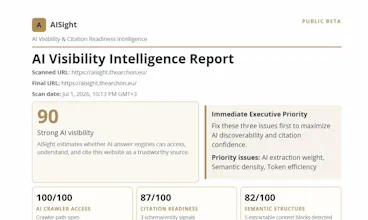
AISight analyzes AI crawler access, semantic structure, citation readiness and evidence quality, then generates an executive report with prioritized findings and copy-paste technical fixes for any public website.
A good executive summary as well as scoring of AI readiness but also does a fairly detailed and thorough technical assessment of key aspects to fix to improve AI citability
Ratings
Ease of use
Reliability
Value for money
Customization
Report
10 views
Maker
📌
Hi Product Hunt!
I'm Dimitris, the creator of AISight.
Over the past few months I've been researching a simple question:
Can AI answer engines actually discover, understand and cite a website correctly?
Traditional SEO tools don't answer that question. They focus on search engines, while AI systems evaluate websites differently.
AISight analyzes AI crawler access, semantic structure, citation readiness and evidence quality, then generates an executive report with prioritized findings and copy-paste technical fixes.
Current beta highlights:
• No login required
• Scan any public website
• Executive PDF report
• Actionable copy-paste recommendations
• Around 30-second analysis
AISight is still in Public Beta and I'm actively improving it based on real user feedback.
I'd really appreciate it if you could try it with your own website and let me know:
• Which findings were the most useful?
• Which recommendations were unclear?
• What would make the report more valuable for your organization?
Thank you for taking the time to test it and share your feedback!
Report
How does AISight actually detect the AI crawlers in practice, does it rely on server log access or just passive DNS sniffing, and does that work for sites behind a CDN?
Report
Maker
@farukwyv5 Great question. AISight doesn’t use server log access or passive DNS sniffing. It evaluates the submitted public URL from the outside, testing the signals and access conditions that affect whether AI crawlers can discover and interpret the site.
So yes, it can evaluate sites behind a CDN, but the result reflects what is publicly observable from outside the infrastructure rather than private origin or server-log data. That distinction is important, and I’ll make it clearer in the product.
Report
love the UI!
Also the fact that it gave my website a 100/100 score pretty much across the board made me happy NGL
It did surface some fixes around trust headers which was a quick fix. Thanks
Report
Maker
@ankit_a hanks Ankit — this is exactly the kind of outcome I hoped AISight would produce: not just another score, but something specific enough to act on immediately. Great to hear the trust header finding led to a quick fix. Really appreciate you testing it and sharing the result.
Report
Ran my site through it and the citation readiness breakdown was surprisingly specific, pointing out schema gaps I didn't know existed. The copy-paste fixes saved me from digging through docs.
Report
Maker
@erol332722 Thanks, Erol — really appreciate you testing the actual report. That’s exactly the outcome I was aiming for: not just identifying a gap, but reducing the distance between “there’s a problem” and “here’s what I can actually do about it.” Great to hear the copy-paste fixes were useful.
Report
Finally checked which AI crawlers actually hit my site and got a copy-paste fix for the structured data issues I didn't know I had—super useful and oddly satisfying to read.
Report
Maker
@turukmen29080 Thanks, Sat — really glad you found the crawler visibility and the structured data fix useful. That’s exactly the kind of outcome AISight is built for: showing what’s actually happening, then making the next technical step clear and immediately actionable. Really appreciate you taking the time to test it and share this.
Report
Ran my own site through AISight and the citation readiness score actually flagged some real gaps. The copy-paste fixes saved me probably an hour of digging through schema docs.
Report
Maker
@emreboyvatexph Thanks, Emre — that’s great to hear. Saving people from digging through documentation and turning a finding into something they can act on immediately is exactly what we’re aiming for. Really appreciate you testing AISight on your own site and sharing the result.
aeo visibility is the new seo, glad someone's actually measuring it 👀 which engines do you track?
Report
Maker
@petrkovacik Thanks, Petr. We currently evaluate visibility and technical readiness across the major AI discovery and answer-engine surfaces, with the focus on whether content can actually be crawled, understood, chunked, and cited. The interesting part for us is not just tracking mentions — it’s identifying what prevents a site from becoming usable evidence for AI systems in the first place.



How does AISight actually detect the AI crawlers in practice, does it rely on server log access or just passive DNS sniffing, and does that work for sites behind a CDN?
@farukwyv5 Great question. AISight doesn’t use server log access or passive DNS sniffing. It evaluates the submitted public URL from the outside, testing the signals and access conditions that affect whether AI crawlers can discover and interpret the site.
So yes, it can evaluate sites behind a CDN, but the result reflects what is publicly observable from outside the infrastructure rather than private origin or server-log data. That distinction is important, and I’ll make it clearer in the product.
love the UI!
Also the fact that it gave my website a 100/100 score pretty much across the board made me happy NGL
It did surface some fixes around trust headers which was a quick fix. Thanks
@ankit_a hanks Ankit — this is exactly the kind of outcome I hoped AISight would produce: not just another score, but something specific enough to act on immediately. Great to hear the trust header finding led to a quick fix. Really appreciate you testing it and sharing the result.
Ran my site through it and the citation readiness breakdown was surprisingly specific, pointing out schema gaps I didn't know existed. The copy-paste fixes saved me from digging through docs.
@erol332722 Thanks, Erol — really appreciate you testing the actual report. That’s exactly the outcome I was aiming for: not just identifying a gap, but reducing the distance between “there’s a problem” and “here’s what I can actually do about it.” Great to hear the copy-paste fixes were useful.
Finally checked which AI crawlers actually hit my site and got a copy-paste fix for the structured data issues I didn't know I had—super useful and oddly satisfying to read.
@turukmen29080 Thanks, Sat — really glad you found the crawler visibility and the structured data fix useful. That’s exactly the kind of outcome AISight is built for: showing what’s actually happening, then making the next technical step clear and immediately actionable. Really appreciate you taking the time to test it and share this.
Ran my own site through AISight and the citation readiness score actually flagged some real gaps. The copy-paste fixes saved me probably an hour of digging through schema docs.
@emreboyvatexph Thanks, Emre — that’s great to hear. Saving people from digging through documentation and turning a finding into something they can act on immediately is exactly what we’re aiming for. Really appreciate you testing AISight on your own site and sharing the result.
Macaly
aeo visibility is the new seo, glad someone's actually measuring it 👀 which engines do you track?
@petrkovacik Thanks, Petr. We currently evaluate visibility and technical readiness across the major AI discovery and answer-engine surfaces, with the focus on whether content can actually be crawled, understood, chunked, and cited. The interesting part for us is not just tracking mentions — it’s identifying what prevents a site from becoming usable evidence for AI systems in the first place.