Your coding agent writes down every shell command, token, and refusal it made, then nothing reads it. Actualis does. Finds exposed credentials, audits what ran, and costs it. No account, no network, one file you can read in a sitting.
Credentials. Real ones, sitting in plaintext in commands my agents had run. Nothing was breached, but they were there, and I had no idea. It now lists them grouped by fingerprint and ranked for rotation, and it never stores or prints the value itself.
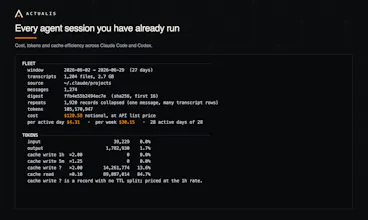
Cost. I was overcounting my own spend by about 2.13x, because transcripts re-emit the same assistant message while a response is streaming. Same message id, same usage, new record. If you sum the column, you get roughly double. That one surprised me more than the credentials did.
It also audits what your agent actually ran, and shows what it was refused, which, as far as I can tell, exists nowhere else — a refused command is never sent to a provider, so nothing watching the API can see it.
It reads files that are already on your machine. No account, no network, no config file. If you would rather not take my word for that, there is an actualis --self-check that verifies it on your machine: which modules the build imports, your transcripts hashed before and after a scan to show they are unchanged, and the one path it can write to. It also prints what it does not prove.
One Python file, no dependencies, AGPL-3.0. Happy to answer anything.