Launched this week

0x8 Post-Quantum Cryptographic Suite
Video Call, Screen Sharing, Chat, File Transfer (WebApp)
2 followers
Video Call, Screen Sharing, Chat, File Transfer (WebApp)
2 followers
0x8: Browser-native Post-Quantum Cryptographic Suite (Video Call, Screen Sharing, Chat, File Transfer) implementing NIST-standardized algorithms at the highest security level: ML-KEM-1024 (FIPS 203) • Kyber-1024, ML-DSA-87 (FIPS 204) • Dilithium-87, SLH-DSA-256 (FIPS 205) • Sphincs+, FN-DSA-1024 (FIPS 206) • Falcon


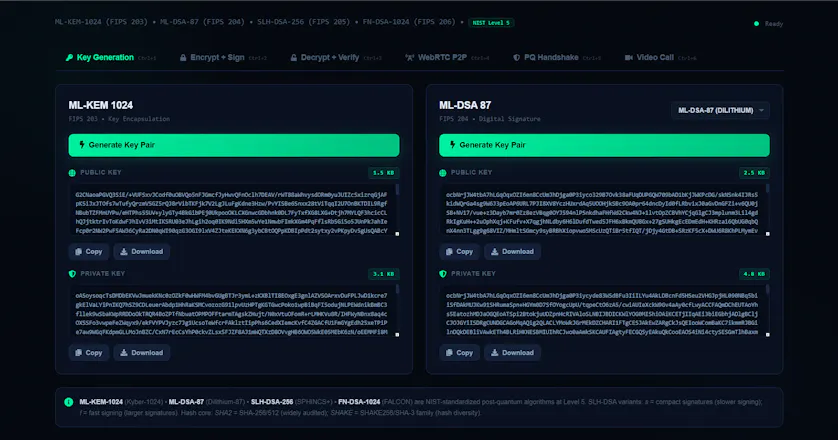


The system offers "Encrypt-then-Sign" hybrid encryption for Video Call, Screen Sharing, Chat, File Transfer (supporting up to 2 terabyte) with a structured binary container format (PQENC), a commit-reveal key exchange protocol with Short Authentication String (SAS) verification for WebRTC peer-to-peer connections, forward-secret ratcheted session encryption for real-time communications.
• A hybrid encrypt-then-sign protocol (PQENC) combining key encapsula-
tion with AES-256-GCM authenticated encryption and NIST Level 5 digital signatures,
with the signature itself bound into the Additional Authenticated Data (AAD).
• A commit-reveal handshake protocol with Proof-of-Possession (PoP) signatures and SAS-
based out-of-band verification, preventing man-in-the-middle attacks even against a ma-
licious signaling server.
• A forward-secret ratcheted session layer using HKDF-SHA-256 per-message key derivation
with separate send/receive ratchet chains, rollback detection, and automatic PQC re-
keying.
• Post-quantum media encryption via WebRTC Insertable Streams and a Web Worker,
applying AES-256-GCM to RTP frames with time-based autonomous ratcheting (3-second
intervals).
• A structured binary container format with magic bytes, versioning, algorithm identifiers,
and length-prefixed fields for unambiguous parsing and integrity verification.