Adam Cohen is the cofounder of @Weave , an engineering analytics company that helps teams go AI-first. Before Weave, he was head of operations and sales at education software firm Top Hat and VP of operations and revenue at @Causal , which was acquired by Lucanet in 2024.








 OpenRouter
Weave Engineering Intelligence
Hey Product Hunt, I'm Adam, Co-founder of Weave!
The Problem
Coding agents send every request to one model. A one-line config change and a cross-service migration both go to the same frontier model at the same price. Teams are paying frontier rates for routine work, and the bill grows with every agent they add.
Most tools in this space follow one of two flawed approaches:
❌ Gateways – They give you one endpoint and a menu of models. You still pick the model yourself, so nothing actually gets cheaper.
❌ Manual model switching – Flipping /model mid-session breaks your prompt cache, and on long sessions the re-billed context eats the savings.
After running into this on our own agent traffic, we built Weave Router to solve it.
How Weave Router 2.0 is Different 🚀
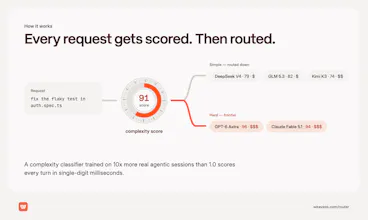
Weave Router plugs into Claude Code, Codex, and Cursor as a drop-in endpoint. It reads every request your agent makes, scores how hard it is, and sends it to the cheapest model that will get it right.
The benchmarks
We ran 2.0 head to head against GPT-6 Astra, each task run twice (pass@2).
📊 Terminal-Bench 4.0 – Tied pass rate within the confidence interval. 52% of Astra's cost. 2.2x faster.
📊 SWE-Atlas Codebase QnA – Tied pass rate within the confidence interval. 46% of Astra's cost. 2.5x faster.
Full results at weaveos.com/router.
🔹 Complexity-scored routing – A new classifier trained on 10x more real agentic coding sessions routes on task difficulty, not task type. DeepSeek, GLM, and Kimi handle the simple turns. Astra and Fable handle the hard ones.
🔹 Cache-aware switching – 2.0 tracks cache state per provider and per session. It only switches models when the expected savings beat the cost of rebuilding the cache. This is where most of the cost win comes from.
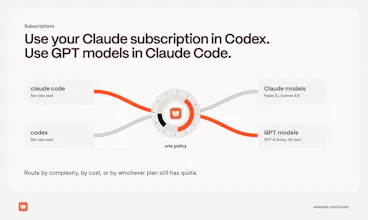
🔹 Multi-subscription routing – Use Claude models inside Codex and GPT models inside Claude Code. Route by complexity, by cost, or by whichever plan still has quota this month.
Who is this for?
If you or your team run coding agents daily, Weave Router gets you Astra-level results at about half the cost and more than twice the speed, without changing your tools.
🔗 Get started today
Try it at weaveos.com/router. Install with one command: npx @workweave/router. Source-available under Elastic License 2.0. Teams of 50+ engineers can book time with our FDEs.
@workweave @adambcohen nice launch ! the routing base on the task difficult instead of just the task type of makes a lot of the sense.
this is a really interesting approach.
congrats on the launch,its a great product. my question to Weave Router team is, what is the most unique feature of your product have that make it different from others products.
Weave Engineering Intelligence
@jacob_hernandez4 We built an analysis model to evaluate to evaluate the path of the entire trace. Also we used a couple of optimizations to significantly shrink the RL search space letting us converge much more quickly and efficiently!
weave is a very great product, they way it reduced the token cost. quick question does weave select all the models for coding or its depend on there models?
Weave Engineering Intelligence
@joseph_duke1 You can select the pool to pick from
how does weave handle token routing when multiple AI models are running together?
Weave Engineering Intelligence
@chandrshekhar_rawen We will select the best one for the given prompt and then for any subagents it calls also have the ability to use different more cost effective agents for any sub task!
Dumper cheaper models are known to produce longer trajectories when solving the same task. What are your thoughts on it in the context of smart routing and cost optimisation?
Weave Engineering Intelligence
@dmytriis Totally agree! We've run a lot of rollouts on production agent traces to measure how efficient each model actually is. On many tasks (usually complex ones, though not only those) dumber models spin their wheels and burn a ton of tokens, so we try to limit the scenarios where that happens. Artificial Analysis publishes a pretty great tokens-per-task score for every model. We try to go a bit deeper by delineating between task complexity and type as well.
Can users set their own preferences for cost versus speed or does Weave handle that automatically?
Weave Engineering Intelligence
@lucyjane both options are available! Default is auto but you can set your own prefrences.
Does it provide any visibility into how much quota each request saves?
Weave Engineering Intelligence
@alheri_murya yes! You can see it on every turn