
Vina
The AI mainkick that hires like your best
62 followers
The AI mainkick that hires like your best
62 followers
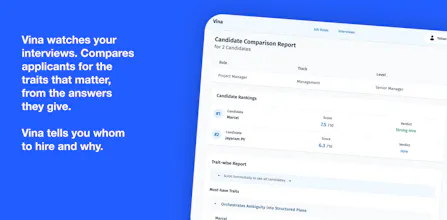
Vina helps your interviewers with the right questions for all roles and levels; listens to the interviews; scores the applicants on every trait that matters for the job; compares applicants, and recommends strong hires, backed up with reasons


Free Options
Launch tags:Hiring
Launch Team

Tines The single, secure environment for agents, apps, and automations.
Promoted
Hiring decisions are among the most critical choices a company makes and also the most quietly biased.
I’ve seen this up close. We all carry internal stories about what makes a “great hire.” Sometimes it’s grit. Sometimes it’s polish. Sometimes, it’s just someone who feels like us. But too often, those instincts overpower actual role-fit.
Vina was born out of this realization. Bias isn’t evil, but it needs guardrails. That’s what Vina does. It brings structure to hiring pipelines. It makes sure every candidate is evaluated for the right reasons, not the familiar ones. Not “who clicks with me,” but “who actually fits this role.”
I’ve made hiring mistakes based on overvaluing a trait I personally respect, only to realize later it wasn’t enough. That one strength blinded me to other gaps. That’s the Halo Effect. And it’s more common than we’d like to admit.
Vina offers a hiring stack that’s not just efficient but fair. It starts from consuming the job description to identify role specific traits, prepares script to drive aligned interviews, does structured evaluations and even compares candidate interviews to find great fit among group of good fits.
If you’re building, scaling, or simply hiring, check out Vina. Would love your thoughts.
Cool.
Any measures built in, to avoid gender/race bias in your tool? When I use it and find good candidates, I just don't want to have to worry about later being accused of using a biased algorithm to make my hire.
Thanks.
Vina doesn't have bias, only preference for your criteria. Evaluation/Selection in Vina is a two phased process - (a) Identify required skills explicitly (b) Rank candidate on identified skill.
This approach leaves the scope for ambiguity in "how candidate was selected" out of the gate by design. Assessment will not have bias for anything which is not part of required skills to get the job done.
Let's be real: we all think we're objective when evaluating talent, but we're not. Before Vina, our process was a mix of gut feelings and personal preferences. Someone would impress us with their communication skills or name-drop their prestigious former employer, and we'd overlook crucial gaps in their actual abilities. Six months later, we'd be scratching our heads wondering why they weren't performing. Sounds familiar? Well, that's how Vina came into the picture. My team was one of the lucky few who got early access to Vina last fall, and it completely changed how we build our teams. After a decade in recruiting, I thought we had a good system in place, only to find out that we were just comfortable with our blind spots.
What makes Vina stand out is how it brings structure to what was previously just 'instinct'. The platform analyses what success in a role actually requires, not what we assume it does. It's like having a neutral third party in the room saying, "Hey, are you sure that's relevant to this position?
Until we tried Vina, I hadn't grasped how wildly inconsistent our evaluation methods were across the team. Some interviewers fixated on technical minutiae while others prioritised communication style—making fair comparisons nearly impossible. With Vina's standardised framework, we're now asking each candidate role-relevant questions that reveal their actual capabilities rather than arbitrary preferences. The transformation has been remarkable: we've shifted from unconsciously selecting people who mirror our own backgrounds and personalities to identifying candidates whose genuine skills and potential align with our needs. The result is a stronger, more diverse team built on merit rather than familiarity.
Here's a perfect example of Vina's impact: Three months ago, we faced the classic dilemma of choosing between several seemingly qualified candidates. While traditional interviews left us torn, Vina revealed crucial distinctions in how each person approached problems. Based on these insights, we selected someone who wasn't necessarily the smoothest communicator but possessed precisely the technical aptitude and collaborative spirit our team needed. Fast forward to today, they've not only integrated seamlessly but are already outperforming expectations. This single hiring decision has validated our entire investment in the platform.
For anyone responsible for building teams, Vina provides the framework to make thoughtful, defensible hiring decisions.
@abishek_prakash2 Thank you!!
This is solving a very real and painful problem. Manual hiring is often inconsistent, interviewers ask different questions, miss key signals, and rely heavily on gut feel. Standardizing interviews and scoring candidates objectively can dramatically improve hiring quality and reduce bias.
@recotap Thank you. This is exactly why we dog-fooded Vina for 6 months.
@recotap Thanks. We found these repeating patterns across companies. Clear example has been how teams change during scaling up workforce. So many hires, so little time, so many competing priorities. Vina brings objectivity to the table in all this.
We made Vina to scratch our own itch. We wanted to hire the 95th percentile consistently, irrespective of the role or seniority. There wasn't a tool that would methodically crack the traits that matter and the questions that would make the applicants think and give a carefully thought out answer.
We went ahead and built Vina. Every hire we make is now based on the questions that Vina gives us. She also reviews all the interviews and gives her view on whom to hire. We mostly agree with her assessment.
Oh, we are looking for strategic partners in the HR/HRTech domains to take Vina to the market. Hit us up through the contact form on our website (https://moative.com)
Interesting product. Hiring has always been a tedious and lengthy process, with the risk of bias creeping in. It's great to see someone addressing this at the root.
@anshul_singh_parihar Thanks a lot! Vina makes it much smoother and bias free.
I couldn’t find a pricing page on the website. Is Vina always free to use?
@michelle_thirteen We are experimenting on pricing and hence no mention yet. We may price per interview.
@moative_ashutosh got it