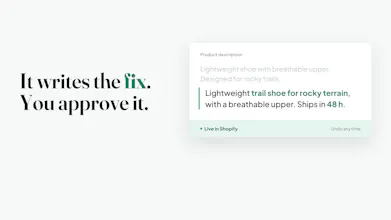
Verity Score tracks what six AI assistants answer about your Shopify store: ChatGPT, Perplexity, Gemini, Claude, AI Overviews and Grok. Every answer is kept verbatim, with its sources. When a page is missing a fact, Verity writes the correction from your own words. You approve it, it goes live in Shopify, and you can undo it any time. It also writes the blog articles your buyers ask for, and rewrites the ones AI cannot use. Then it measures the visits and orders AI really sent you.
Verity Score shows a Shopify merchant what six AI assistants answer about their store, writes the missing facts back into the store, and counts the orders AI sent.
Two founders, Kamil and Jonathan, built it with 8 Codex x20 on GPT6 Astra, in parallel on separate tracks
Engines: the catalogue crawler, the prompt runner that queries six assistants and keeps every answer verbatim with its sources, and the attribution that reconciles AI visits, carts and orders against Shopify data.
Design: the embedded Shopify app and the marketing site, French and English.
Features: prompt tracking, the correction writer that publishes into Shopify after approval, the article generator and rewriter.
Recommendations: which missing fact kept a store out of an answer, and in what order to fix it.
Research: how assistants source and cite, turned into engine checks.
Parallel agents only work with clear boundaries. Most of the work was the tests that let 8 tracks land without breaking each other.
The part I care most about as an e-merchant myself is what the merchant can check at the end. With Verity Score, they can read the assistant's answer and its sources, then review a proposed correction before it goes into Shopify.
For anyone building a similar workflow with coding agents, I'd start the review with a few concrete questions: What supports this new product claim? What exactly will change when I approve it? How do I undo it?
Which part has been hardest to test in your own app?
Hey Product Hunt 👋
We are Kamil and Jonathan, the two founders behind Verity Score.
Your buyers have started asking ChatGPT, Perplexity, Gemini, Claude, AI Overviews and Grok about your store. You never see those answers. We built Verity Score so a Shopify merchant finally can.
It asks the questions your buyers actually ask, across all six assistants, and keeps every answer word for word with its sources, so you can check it instead of trusting a score.
When a page is missing a fact, and that is usually why a store gets left out of an answer, Verity writes the correction from your own product data. You approve it, it publishes into Shopify, and you can undo it any time.
It also writes the blog articles your buyers keep asking an assistant for, and rewrites the ones AI cannot use. Then it counts the visits, the carts and the orders AI actually sent you, read from your own Shopify data. Nothing estimated.
Where we differ from the rest of the category: most AI visibility tools stop at the dashboard. They tell you that you are invisible. Verity writes and ships the fix, inside the store, then measures whether it worked.
On the GPT-6 Astra Challenge: we built the whole thing with Codex x20 on Astra, 8 agents in parallel on separate tracks. The surprise was not the speed. It was that the bottleneck moved from the model to the boundaries, so most of the work became writing the tests that let 8 tracks land without breaking each other.
Two things we would love feedback on:
If you run a Shopify store, what question would you type into ChatGPT to check whether it recommends you?
Would you let an app publish a correction to your product page, or does approval need to be finer than one button?
We are here all day.
On Kamil's question about approval: a small edit can change what a merchant is promising. Adding a material is one thing; changing a delivery estimate or a return condition deserves a much closer look.
Verity Score lets you preview a correction before approving it for Shopify. I'd love to hear where you'd want more control: each individual change, each product, or a batch of similar fixes? A concrete example from your store would be especially useful.
Here's a practical way to start checking your store's AI visibility.
Pick one product and one question a buyer would ask before ordering. For a sofa cover, for example: 'Will this fit a corner sofa, and can I machine-wash it?'
Ask an assistant, read the answer and follow any sources it gives and then compare the claims with your product page. If the dimensions or washing instructions are missing, add the verified details. If the answer is wrong despite the information being there, keep that as a separate issue to investigate.
Verity Score is THE Shopify app for generative engine optimization (GEO): tracking AI answers and preparing product-page corrections for merchant review.
What's the one detail about your products that customers keep asking you to clarify?





Verity Score
Verity Score
The part I care most about as an e-merchant myself is what the merchant can check at the end. With Verity Score, they can read the assistant's answer and its sources, then review a proposed correction before it goes into Shopify.
For anyone building a similar workflow with coding agents, I'd start the review with a few concrete questions: What supports this new product claim? What exactly will change when I approve it? How do I undo it?
Which part has been hardest to test in your own app?
Verity Score
Verity Score
On Kamil's question about approval: a small edit can change what a merchant is promising. Adding a material is one thing; changing a delivery estimate or a return condition deserves a much closer look.
Verity Score lets you preview a correction before approving it for Shopify. I'd love to hear where you'd want more control: each individual change, each product, or a batch of similar fixes? A concrete example from your store would be especially useful.
Verity Score
Jonathan of Verity Score here.
Here's a practical way to start checking your store's AI visibility.
Pick one product and one question a buyer would ask before ordering. For a sofa cover, for example: 'Will this fit a corner sofa, and can I machine-wash it?'
Ask an assistant, read the answer and follow any sources it gives and then compare the claims with your product page. If the dimensions or washing instructions are missing, add the verified details. If the answer is wrong despite the information being there, keep that as a separate issue to investigate.
Verity Score is THE Shopify app for generative engine optimization (GEO): tracking AI answers and preparing product-page corrections for merchant review.
What's the one detail about your products that customers keep asking you to clarify?