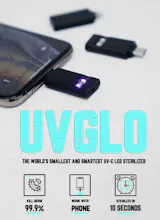
UV GLO

Sterilize your keyboard and desk with your phone

1 follower

UVGLO is equipped with a far ultraviolet light emitting diode(LED) with peak emission wavelengths to bring you a thoroughly battery free, 99.9% germ kill, and 10s immediate radiates sanitizing experience when plugged to a smartphone.
UV GLO gallery image
Launch Team
Anima Playground
AI with an Eye for Design
Promoted

What do you think? …

Emily Hodgins
Does this really work? Any scientists around to shed any more light?
Simon Bromberg
@emilyjsnowdon first of all, whether it works or not, why exactly is this something one would need? The average person is not doing tasks that require sterilization. There is bacteria everywhere, there's no need to go around killing it — the large majority of it is not harmful, and good hygiene will work most of the time otherwise. Even with this thing (assuming it worked), you're not going to be constantly using it on every thing (or person) you touch. Looking at the video, that tiny little UV light is extremely unlikely to be strong enough to have any effect, especially if they're just quickly passing it over a surface as shown. Even on the Indiegogo page they say you need 10 – 40 seconds, but they're passing that tiny light over spots for only a second or two. UV sterilization is definitely a thing, but the idea that you could and should use it all day like this is ridiculous. They don't even address questions of efficacy on their FAQ page. Looks like an attempt to capitalize on people's fears, and unfortunately it's worked since they managed to get funding for it. Oh and exposure to UV can cause sunburns and cancer (and damage your eyes) so there's that too…
Edwin Klesman
@emilyjsnowdon check out the article in my response. It has links to scientific researches to back up its story ✌🏻
Charles Magnuson
Might as well call this product iGlaucoma if it actually worked. In reality, this is a piece of sham-ware.
Sam Decrock
If it works, it's just to dangerous to have it around. Dyson uses UV to kill bacteria in their humidifier, but it has a special military grade housing protecting you from the light.
Josh Hunter

Disinfecting is not that easy. Be real people. A tiny UV light powered by your phone is never going to be remotely powerful enough to kill bacteria. This is just another Indiegogo scam. Don't buy into it.

Pros:

None

Cons:

It's a sham product.

Jane Sorensen
The ad is really bad. I would not want to be friends with this girl, and it only encourages people who ARE like this that this is valid and normal behaviour. Marketing: "Address a fear!" Psychology: "Alleviate a fear and turn it into something productive!" Marketing: "Yeah, cha-ching!" Psychology: {facepalm} Full disclosure: I'm a biologist. That people need to give their immune systems something to do is no lie. Engineers need to start taking real ecological biology and behaviour ramifications into account.
Edwin Klesman
The only things I really like to sterilize from time to time (with pressure air and wet wipes) are the keyboard of my Macbook Pro and sanitary places. Especially when I've had a cold or people around me are having one. I Googled 5 seconds and found this very interesting(!) article that sheds a light (pun intended) on the (scientific) history of UV lightning sterilization: https://www.researchgate.net/pub... The article also has some great facts on when LED UV lightning becomes effective (keep in mind that the UV GLO is a UV-C type LED solution). I recommend reading the article for anyone interested in the history, development and applications for UV LED light. The highlights that are (IMO) related to the UV GLO are listed below (some spaces and reading marks have been edited but the content is the same): 1)As with traditional UV sources, LEDs in the UV-C and UV-B range are effective at inactivating bacteria and viruses (Bowker et al., 2011; Oguma et al., 2013; Beck et al., 2017; Rattanakul and Oguma, 2018) and helminths eggs as well (unpublished). These UV LEDs currently are used in small reactors for batch experiments (Figure 4). LEDs in the UV-A range can degrade harmful organic pollutants like pharmaceuticals, insecticides and dyes, with the help of photocatalysts like iron, titanium-oxide and persulfate (Matafanova and Batoev, 2018) 2) From a health and environmental impact standpoint, the primary advantage of UV LEDs over other UV lamps is that they are mercury-free. Mercury has toxic effects on human health and the environment. 3) For UV-B and UV-C LEDs to be as effective as traditional UV lamps from a microbiology perspective, they must reach wall plug efficiencies of 25 to 39 percent, meaning that 25 to 39 percent of the energy input through the wall plug is output in the form of light (Beck et al. 2017). Given the current state of technology, the wall plug efficiencies of these LEDs is closer to 4 percent. However, they are on an upward trend and well on pace with the development of red, blue and UV-A LEDs 4) UV-C LEDs are already being incorporated into point-of-use units to serve the defense and outdoor industries. They’re being designed into airplanes to disinfect air in the passenger cabin, and they ’re being tested for water treatment in small towns in the United States. 5) In developed countries, UV-C LEDs can be incorporated into showerheads to prevent outbreaks of Legionnaires’ disease in hospitals and hotels. They can be introduced into pipe systems to prevent biofilm formation. In low- to middle-income countries, UV-C LEDs can be designed into hand-pumps to disinfect groundwater or studded in bottle caps to treat single bottles of water and prevent disease outbreaks. As with every exciting new technological development, the broad array of applications cannot yet be foreseen; however, it is exciting to watch the transformation unfold. The main point I'm interested in is #3: what is the energy efficiency of the device and what is the recommended time to sterilize a small area like a standard laptop keyboard, for instance?
Balance and Sun
this is a good idea. does it work though?