
The Model Graveyard
Know when your AI model dies — before your app breaks
11 followers
Know when your AI model dies — before your app breaks
11 followers
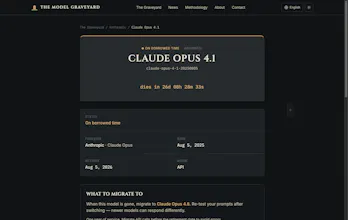
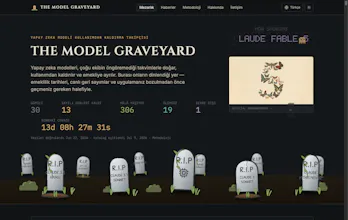
Track AI models in one place: LLM releases, Claude & Gemini models, open-source models, deprecations and retirement dates. The living list of AI models.


Dial
Serhat's question above about silent provider updates is the one I'd want answered before relying on this day to day. "computed from real provider dates" is only as good as providers actually publishing a real date - and the whole reason people get bitten by deprecations is that OpenAI/Google/Anthropic don't always announce them cleanly, sometimes it's a quiet routing change or a model that just gets worse before it formally disappears. is the list built from official changelogs/docs only, or does someone also watch for the unofficial signals (community reports, API behavior changes) that don't come with a real date attached
@galdayan You've nailed the actual failure mode, Gal — this is the right thing to push on. Straight answer, two layers:
Official: the curated core is hand-verified against provider deprecation docs/changelogs + endoflife.date, each with a cited source. You're right that's only as good as what providers publish.
Unofficial (API behavior): this is the important half. A daily job checks what's actually being served on OpenRouter + models.dev. So a quiet routing change or a model silently vanishing does get caught — if it stops being served, the status flips with no announcement needed. That's the signal without a date attached.
Where I'll be honest about the gap: it tracks availability + announced dates, not quality degradation. The "gets worse before it formally disappears" case — a model quietly regressing while still served — I don't track that today. It's a real limitation, and a hard one without a benchmark harness. I act on community reports of "this one's acting off," but there's no automated quality-drift detection yet.
If you've got a signal you trust for catching silent regressions, I'm genuinely all ears — that's the frontier here. 🙏
Dial
@datahunt honest answer, respect that. community reports as the stopgap for quality-drift makes sense given there's no clean automated way to measure it yet - a benchmark harness would need a fixed eval set run daily per model, and even then you'd be fighting noise from provider-side load balancing, not just genuine regression. if you ever do add that layer, I'd watch it closely. for now the availability-flip signal alone is more than most trackers give you.
How do you keep the model list updated in real time, especially when providers like OpenAI or Google push silent updates without an official changelog?
@serhatkulaber Great question, Serhat — it's the core of the whole thing. It's not real-time-to-the-second; it's a daily automated refresh with two kinds of signal:
Announced dates — from provider deprecation docs + endoflife.date, hand-verified for the notable models (each cites its source).
Live availability — every day it checks what's actually being served on OpenRouter and models.dev (which also covers Azure/Bedrock/Vertex). So when a provider silently pulls or reroutes a model with no changelog, it stops showing up as served → its status flips automatically.
So silent removals get caught by the availability check even when there's no official date attached. Where would you want it tighter than daily?
Really appreciate how clean and focused this is - just the model list without any fluff. The deprecation tracking in particular is something I've been wanting forever.
@mihriban5dyg "Wanting forever" — that genuinely made my day, Mihriban 😄 No-fluff was the whole ethos. If you ever spot a model that's missing or a date that looks off, ping me — I keep it updated daily. (It's fully in Turkish too, btw 🇹🇷)
Finally a single spot for tracking which Claude and Gemini versions are still alive or sunset. The deprecation dates alone saved me a few hours of digging through release notes.
@reyhanorak2xlr That's the exact pain that started this, Reyhan 🙏 I was tired of grepping through changelogs only to find a model I depended on was already sunset. Glad it's saving you the digging! Which provider's release notes do you find hardest to keep up with?
The filtering by deprecation dates is genuinely useful — most trackers just dump a wall of releases and expect you to hunt for what's still alive. Nice clean execution.
@songlqa6b Appreciate that, Songül! The "wall of releases" thing is real — I wanted the default view to answer one question: what's dying, and when. Is there a filter or sort you'd want that isn't there yet?
Love how lean and focused this is, no clutter, just the signal of what matters in a fast-moving landscape. The deprecation tracking alone is genuinely useful.
@dndlerx Thank you, Döndü — "signal, not clutter" was literally the design goal, so that means a lot 🖤 Keeping it lean was the hard part. What's the first thing you check when a model flips to "on borrowed time"?