Kodezi

Kodezi

AI CTO for your codebase

3.8
4 reviews

1.7K followers

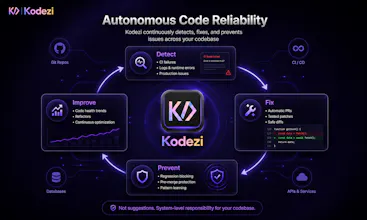
Kodezi is an autonomous operating system for codebases, built to maintain, heal, and evolve software across every layer of the stack.
This is the 3rd launch from Kodezi. View more

Kodezi Chronos-1

A debugging-native language model
Kodezi Chronos-1 is a language model purpose built for debugging. While most models focus on generating code, Chronos-1 learns how code behaves, why it breaks, and how to fix it. It performs autonomous bug localization, traces logic paths, and produces validated repairs. Its debugging-driven design uses a memory engine trained on millions of real bugs and adaptive retrieval that scales across entire repositories.
Kodezi Chronos-1 gallery image
Free Options
Launch Team / Built With
ace.me
ace.me
Your new website, email address & cloud storage
Promoted

What do you think? …

Ishraq Khan

Hey everyone, Ishraq here.

Today we are excited to launch Kodezi Chronos-1.

Four years ago, while I was still in high school, I launched the very first version of Kodezi on Product Hunt. It was a small experiment built to be a Grammarly for code, but that launch started the journey that led to everything we are releasing today.

Since then, we have built and released a full suite of products. Kodezi Web IDE, Kodezi VS Code, Kodezi Chat, Kodezi CLI, and Kodezi CI/CD. Each one taught us how developers write, understand, and maintain software in real environments.

Across millions of sessions, one pattern became clear. Code generation is easy. Real debugging is not.

No tool, including our own early versions, could reliably solve multi-file issues inside real repositories. So we went deeper.

We rebuilt our infrastructure, designed a new retrieval engine, and created a training pipeline centered on real debugging data. Millions of bugs, CI logs, stack traces, fix attempts, and full repository histories.

That work led to Chronos-1. Chronos-1 is the first large language model designed for debugging from the ground up.

Most models autocomplete. Chronos-1 learns how code behaves, why it breaks, and how to repair it. It searches across your repository, identifies root causes, tests patches, and refines until the fix succeeds.

What makes Chronos-1 different
• Debugging-first architecture
• Multi-level memory engine trained on millions of bugs, logs, and tests
• Adaptive retrieval that scales across entire repositories
• Higher bug detection and fewer debugging cycles in real evaluations
• Native integration with IDEs, CI/CD, and observability tools

Chronos-1 also powers Kodezi OS, our AI native CTO that autonomously maintains and evolves entire codebases. Kodezi OS leaves beta in Q1 2026.

Launching here on Product Hunt feels full circle. Kodezi began here as a simple idea. Today we are releasing a debugging model built for real engineering teams and real production workloads.

We recently raised a new round and are hiring engineering and product talent. If you want to help build a future where software can improve itself, message me.

Resources

Paper: https://arxiv.org/abs/2507.12482

Chronos: https://chronos.so/waitlist

Kodezi OS: https://kodezi.com/os

The waitlist and early access signups open today. Thank you for the support!

Masum Parvej

@ishraqkhan chronos‑1 digging thru repos to find root cause feels like dream tool. does it integrate smooth with vs code?

Calvin Kibet

@ishraqkhan The adaptive retrieval is key. Context is everything in debugging.

Olivfurn

@ishraqkhan Is this better than the previous chronos?

Md Tareq

@ishraqkhan Congrats on shipping after three years of research!

42ShadesOfArt

@ishraqkhan Congrats on making it from high school idea to funded startup!

Cawt Lover

The "autonomous bug localization" is what I need. Finding WHERE the bug is takes 80% of my debugging time.

Ishraq Khan

@cawt_lover Exactly. That’s the part Chronos was built to crush. It scans the whole repo, traces the logic path that produced the failure, and pinpoints the file and line where things went off. Most users tell us the time savings come from that localization step alone.

Kida Tumi

Does Chronos work with GraphQL APIs?

Ishraq Khan

@kida_tumi Yes. Chronos understands GraphQL schemas, resolvers, queries, and error patterns. It can trace failures through the resolver chain, spot schema mismatches, and explain the root cause before proposing a fix.

Extra 7399

How does Chronos handle microservices where bugs span multiple services?

Ishraq Khan

@extra_7399 Chronos is built for that. It uses multi hop retrieval across services, traces how data flows between them, and maps the chain of events that produced the failure. Instead of guessing in one repo, it pieces together the full cross service story and surfaces the real root cause.

Emmanuel Jenga

The Kodezi OS concept of an AI-native CTO is ambitious. Excited to see where that goes in 2026.

Ishraq Khan

@emmanuel_jenga Appreciate that. The AI native CTO idea is big, but it’s grounded in real workflows. Chronos handles the debugging layer, and Kodezi OS builds on top of that to watch code health, plan fixes, and keep things stable as teams scale. 2026 is where it all comes together.

Farid Official

How does Chronos handle authentication and security bugs?

Ishraq Khan

@farid_official Chronos is strong on auth and security issues. It analyzes the full request flow, permission checks, token handling, and config settings, then pinpoints where the breakdown happens. It also flags insecure patterns and proposes fixes that align with best practices without exposing sensitive data.

Desper

Does Chronos support custom testing frameworks or just the major ones?

Ishraq Khan

@desper2 It supports both. Chronos understands the major testing frameworks out of the box, but it also learns from your project’s own tests, fixtures, and failure patterns. As long as the framework produces logs or output, Chronos can parse it, trace the failure, and generate fixes.

123
Next
Last