
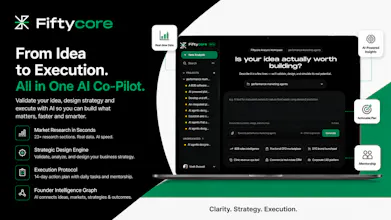
1. Market Validation - Know if your idea has real demand before committing. 2. Reality Simulator - See your startup's success, stagnation, or failure before building. 3. Due Diligence Deep Dive - Investor-grade risk analysis on demand. 4. Execution Protocol - Daily tasks + AI mentorship so you never stall. 5. Founder Intelligence Graph - Maps your startup and you as a founder.



Dial
the reality simulator part is the one I'm stuck on - predicting stagnation vs failure sounds like it needs some real base rate data, not just the inputs I give it about my own idea. is it trained on outcomes from actual startups that succeeded/failed, or is it more reasoning from the info you feed it plus market research it pulls live?
@omri_ben_shoham1 Great question, Omri. It's not a model trained on historical startup wins and losses - it works by cross-referencing what you give it with live market conditions, comparable signals, and realistic constraints. Less "what happened before" and more "what does the landscape actually look like for this." No fake confidence, just grounded logic.
Dial
@Vivek Dwivedi appreciate the distinction, "grounded in live constraints" vs "pattern-matched from history" is a real difference. what happens for a genuinely new category though, something like an emerging niche where there aren't many comparable signals yet - does it tell you straight up that confidence is low, or does it start leaning on adjacent categories in a way that could quietly turn back into pattern-matching?
@omri_ben_shoham1It does use adjacent markets, but they're treated as contextual evidence rather than proof. The report distinguishes between observations supported by direct signals and inferences drawn from related categories, so users can see where the conclusions come from instead of receiving a single overconfident answer.Our goal isn't to eliminate uncertainty. It's to make uncertainty visible while still providing the most grounded decision support possible.
honestly the reality simulator sounds kind of cool but it would be even better if it could compare your idea side by side with similar startups that already exist, basically a quick competitive snapshot so you know what you are up against before you even start.
@melisafk81 Melisa, love this take - basically a "who else is doing this?" check before you commit. We're playing with ways to do that. Thanks for the push! 🎯
I used the beta model, gives amazing insights. 100% worth it.
The best part is it’s not generic like Chat gpt and claude, showing me very specific results.
Im surprised to see this tool is relevant in architecture related ideas too, very specific and fluent in research no generic answers.