Launching today
CostPilot

CostPilot

Terraform cost diffs at PR time. No IAM, no APIs.

1 follower

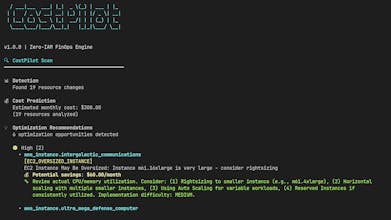
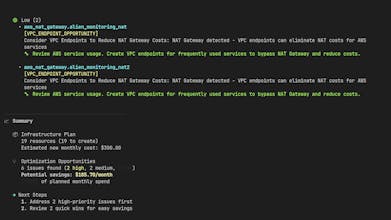
CostPilot is a local CLI that estimates infrastructure cost deltas from Terraform plans before merge. It consumes terraform show - json output and evaluates cost changes entirely offline using deterministic heuristics - no cloud APIs, no IAM roles, no network access. The goal is not billing-exact totals, but fast, reproducible feedback during code review, where infrastructure decisions are still reversible.
CostPilot gallery image
Free Options
Launch Team
Intercom
Intercom
Startups get 90% off Intercom + 1 year of Fin AI Agent free
Promoted

What do you think? …

Deon Prinsloo
Maker
📌
Hi Product Hunt, I built CostPilot to answer a narrow question: is infrastructure cost feedback more useful before merge than after deploy? CostPilot is a local CLI that estimates cost deltas from Terraform plans. It works by consuming terraform show -json output and evaluating changes entirely offline using embedded pricing data. There are no cloud API calls, no IAM roles, and no network access at runtime, which keeps the output deterministic and cheap enough to run in CI. The motivation came from a specific frustration. Cost feedback usually arrives after deploy, when the change is already merged and normalized. Terraform plans already describe irreversible infrastructure decisions, so estimating cost there makes it part of code review instead of a billing post-mortem. Design constraints I cared about: deterministic execution (same input, same output) fully offline execution intended to run before merge, not after deploy directional accuracy rather than billing-exact precision Real trade-offs: it cannot model runtime behavior like autoscaling or traffic it is weak at usage-driven costs such as egress it will not match provider bills to the cent This started as a small experiment extracted from real CI workflows. I am mostly interested in whether this timing and constraint set makes sense, not in building a general FinOps platform. Happy to answer technical questions or hear where this approach breaks down.