
Launched this week

Converge
AI vibe coding platform built on Convex
17 followers
AI vibe coding platform built on Convex
17 followers
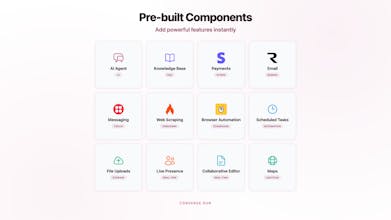
Converge is a full-stack AI app builder built on Convex (not Supabase). Our agent builds better apps because with Convex, the entire backend is expressed as code. No separate SQL layer, migrations, or dashboards. Schema, auth, and background jobs are all generated and versioned in TypeScript. Also: -Batteries included: database, auth, file uploads, background workflows + scheduled tasks -Pre-built components: AI Agent, RAG, Payments (Stripe), Email (Resend), Web scraping (Firecrawl) + more



why did you choose convex for the backend?
@arianna_luna1 thanks for the q!
Main reasons:
1. Typescript from backend to frontend (one language that AI knows well)
2. Everything is managed in code (database schema, app state, auth, etc), makes it easy for the agent to keep everything in context
@arianna_luna1 Here's my long-winded CTO answer also
With Convex, everything (your database schema, queries, and backend logic) is written in TypeScript files that live in the same codebase as your frontend. AI models have been trained on massive amounts of TypeScript, so they generate accurate, reliable code consistently. This means fewer bugs and faster iterations when building your app.
Most other vibe coding platforms use Supabase, which is built on PostgreSQL. The challenge is that SQL databases define data in a completely different language and location than your app code. Agents have to context-switch between TypeScript and SQL, manage migration files, and reason about security policies written in declarative syntax. In practice, AI agents regularly get stuck on these things because they live outside the normal procedural codebase.
Convex ran Fullstack-Bench comparing AI agent performance across backends. For a chat app task, Convex completed in 3 1/2 minutes with zero human interventions. The same task on Supabase took 30 minutes with 16 interventions. The AI could solve authorization rules in one shot on Convex because they're just TypeScript functions; no SQL to debug.
Convex is also reactive by default. Your UI automatically updates when data changes; no WebSockets to configure, no cache invalidation to manage, no state sync bugs. Convex removes an entire class of problems that AI agents typically struggle with.
TLDR;
Everything is TypeScript → AI models generate better code with fewer hallucinations
Schema, queries, and logic live in one place → agents understand your data without context-switching
No SQL or migrations → one language, end-to-end type safety
Reactive out-of-the-box → UI stays in sync automatically, no extra code needed
API endpoints are just Convex functions → Easy to write and consume APIs with automatic caching and atomic transactions