
Launched this week

CodeWeave
DevOps & GenAI copilot grounded in official docs
8 followers
DevOps & GenAI copilot grounded in official docs
8 followers
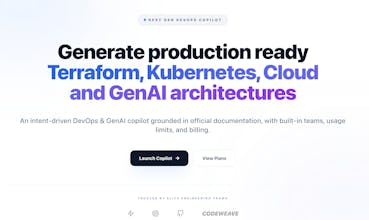
Production-ready infrastructure from prompt. CodeWeave generates complete Terraform, Kubernetes, CI/CD pipelines, and Cloud + GenAI architectures - deployable systems grounded in official documentation. Covers CI/CD, Kubernetes, cloud infrastructure, security, troubleshooting, and GenAI architectures with built-in teams, quotas, and billing for real production use. Try free at copilot.codeweave.co





Hey Product Hunt 👋
I’m Mujib, founder of CodeWeave.
After years working as a principal DevOps engineer, I kept running into the same problem: teams spend huge amounts of time rewriting Terraform, Kubernetes, and CI/CD for every new project, even though the intent is usually clear.
So I built CodeWeave to generate production-ready infrastructure systems, not snippets.
Some example prompts you can try:
“Create a GitHub Actions pipeline with OIDC auth and blue/green deployment”
“My Kubernetes pods are crashing due to maxed-out DB connections - find the root cause”
“Design a serverless API with auth, monitoring, and rollback”
The outputs are deliberately comprehensive, including security, deployment strategy, and operational considerations, because that’s what real infrastructure requires.
Happy to answer questions about:
How we avoid hallucinated infrastructure
Why we focus on intent rather than tool syntax
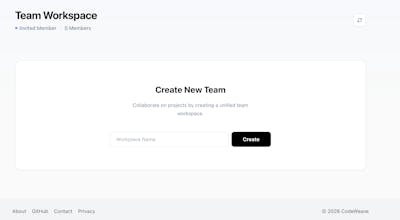
How teams, quotas, and billing are handled
The underlying tech choices
What infrastructure task would save you the most time right now?
Website: codeweave.co
Congrats on the launch! It is a great product
How does CodeWeave avoid hallucinating or guessing when generating infrastructure code?
@fazilath Great question, this was a core design decision for CodeWeave.
CodeWeave is built around a zero-assumption policy. Before generating infrastructure or architecture output, it grounds the model against official documentation (Terraform, Kubernetes, cloud providers, CI/CD tools).
If the documentation doesn’t explicitly define something, CodeWeave does not guess. Instead, it clearly states that the information isn’t available or requires confirmation.
We also use strict system constraints and template-level rules that prevent “confident-but-wrong” defaults, and trigger a soft refusal when a grounded answer isn’t available.
The result is output that’s slower but far more trustworthy for real infrastructure, compliance, and production systems.
Congrats on the launch! the app looks like a powerful way to collapse weeks of DevOps + GenAI setup into a single prompt. Out of curiosity, is CodeWeave built primarily for solo builders, startups, or larger teams — or all of the above?
And what kind of team do you think benefits the most from CodeWeave right now?
@alessandro_ansa Thank you 🙏
CodeWeave is intentionally built to support all three, but with different value at each stage.
Solo builders benefit by skipping weeks of setup and avoiding expensive trial-and-error when working with Terraform, Kubernetes, CI/CD, or GenAI stacks.
Startups get the most value right now, fast, production-grade architectures without needing a full platform team, plus guardrails around security, observability, and cost from day one.
Larger teams use CodeWeave more as a force multiplier: standardising patterns, reducing cognitive load, and accelerating design and troubleshooting without replacing existing workflows.
Today, early-stage startups and small platform teams see the fastest impact, while enterprise-grade features (policy enforcement, deeper integrations, and org-level controls) are what we are expanding next.