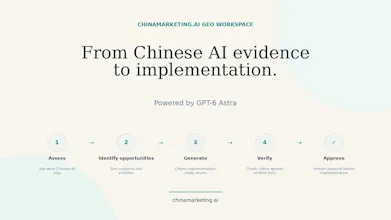
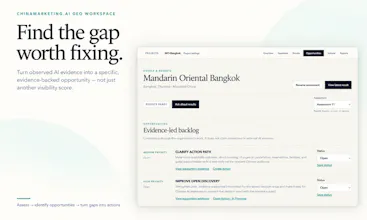
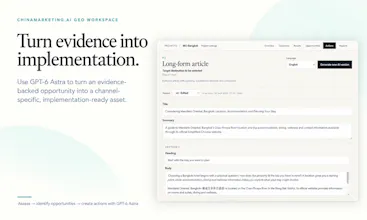
ChinaMarketing.AI GEO Workspace shows brands how they appear across Chinese AI discovery journeys, then turns evidence-backed gaps into implementation-ready action. GEO Actions uses GPT-6 Astra to create channel-specific assets from verified brand facts, check material claims against those facts, route them through human approval, and record the exact version implemented.
How did Astra change the scope or ambition of what you built?
Maker
GPT-6 Astra turns observed Chinese AI visibility gaps into implementation-ready GEO actions. It generates channel-specific assets from bounded evidence and verified brand facts, then checks material claims before the exact version can be approved and implemented.
Report
Maker
📌
Hi Product Hunt — I’m Subbu, founder of ChinaMarketing.AI.
We built GEO Workspace because brands kept asking us a simple question: what does Chinese AI actually say about us, and what should we do about it?
The first part became our assessment workflow: structured Chinese-language testing across major AI environments, with the underlying evidence preserved rather than reduced to a single visibility score.
But that exposed the next problem: diagnosis is not implementation.
That led to GEO Actions.
An Action starts from an evidence-backed Opportunity. The team adds the operational facts it can verify, chooses where the improvement will be used, and GPT-6 Astra turns that bounded context into an implementation-ready asset.
The important part is what happens next. We didn’t want another AI content generator, so material claims are checked against verified facts before approval. Unsupported claims have to be resolved, edited or removed.
The workflow is now:
AI evidence → Opportunity → Action → verified asset → implementation
We’re deliberately keeping a human approval step for now rather than jumping straight to autonomous publishing.
I’d love feedback on that boundary: where would you let AI act autonomously, and where would you still want a human in the loop?