Launching today

Microsoft-Decision-1
Microsoft’s decision model for agents and workflows
18 followers
Microsoft’s decision model for agents and workflows
18 followers
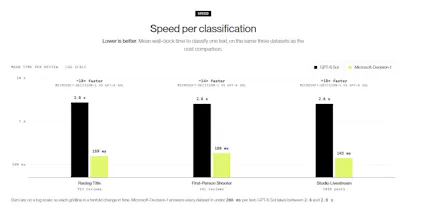
Microsoft-Decision-1 is a decision-scoring model for routing, classification, verification and agent control. Give it fixed options and it returns a calibrated probability for each in a single pass, as structured output software can act on directly. Post-trained from Qwen3.5-9B, it is about 35x faster than GPT-6 Sol at median latency, per Microsoft. Available now in Microsoft Foundry at $0.042 per million input tokens, with free output.



Meet Microsoft-Decision-1 from Microsoft: a model built for fast, structured decisions, not text generation. You give it a situation and fixed options, and it returns a calibrated probability for each one in a single pass, so your software can act on the answer directly.
You now get:
Probabilities for yes/no, multiple-choice and rating options, with no text to parse
Rubric-based grading of AI responses and agent actions, through a structured API call
A small, fast model post-trained from Qwen3.5-9B for decision scoring, which Microsoft says it will rebase on other models, including Microsoft AI (MAI) and OpenAI models
What’s new?
Built for decisions, not chat: LLMs generate text or reason through complex problems. Decision-1 handles routing, classification, prioritization, verification and workflow control, where the answer is a choice among known options.
Speed that adds up: Microsoft’s example is that 100 ms added to each of 20 sequential decisions adds two seconds to a workflow. In its tests, Decision-1 is 4.5x faster than the runner-up (Quyet-1.0-Large) and about 35x faster than GPT-6 Sol at median latency.
Accuracy and generalization: Microsoft reports the highest accuracy in a 36-benchmark comparison covering nearly 150,000 questions kept blind from training, and the best results on JevBench across 36 additional public and private benchmarks.
Consistent decisions: Across eight types of input changes, it changes its decision on 1.3% of cases on average, and never when option descriptions are paraphrased or options are reversed or shuffled.
Safety: It was tested on 5,250 requests across 11 benchmarks (harmful content, jailbreaks, prompt injection), and Microsoft says it refused harmful behavior while keeping high utility.
Where Microsoft is already using it:
Xbox Research labeled more than 10,000 pieces of feedback at quality competitive with GPT-6 Sol, over 14x faster and 200x cheaper
The Copilot team saw quality competitive with GPT-5.6 Luna at 100x the speed
Microsoft Discovery got scores 46x more consistent than the LLM-based version, at three times the speed
Listed use cases: agent controls, model routing, data labeling, AI judging, intent analysis, incident routing, data validation, search relevance, content filtering, code scanning, safety screening, computer use, robotics and scientific discovery.
Pricing and availability:
Available now in Microsoft Foundry
OpenRouter is coming soon
$0.042 per million input tokens, and output tokens are free
Try it: Microsoft Foundry · Launch post