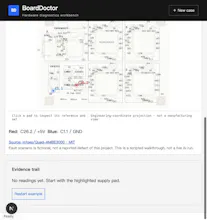
BoardDoctor turns KiCad and LCEDA projects into guided PCB troubleshooting. It maps each diagnostic check to real pads and nets, then uses measured evidence to choose the next step. Try the 60-second investigation, or import your own board.
How did Astra change the scope or ambition of what you built?
Maker
GPT-6 Astra moved BoardDoctor from a static checklist into an evidence-driven diagnostic agent. Instead of asking users to describe a failure in a blank text box, Astra reasons over structured KiCad and LCEDA project data, proposes the single highest-information measurement, reads the returned evidence, and replans the next probe. Its long-context reasoning keeps schematic intent, PCB connectivity, test history, safety constraints, and uncertainty inside one investigation. That made the ambitious part possible: a board-agnostic workflow that imports a real design, points to physical pads and nets, explains why a measurement matters, and converges toward a fault instead of producing a generic answer. Deterministic fallbacks and visible evidence traces keep the result inspectable.
Report
Maker
📌
I built BoardDoctor after seeing how often PCB debugging starts with the same question: where should I probe next? It turns an engineering project into a visible, evidence-driven investigation. Import KiCad or LCEDA data, inspect real pads and nets, record a measurement, and let the planner narrow the fault instead of guessing. I would love feedback from hardware engineers on the investigation flow and the next EDA integrations.