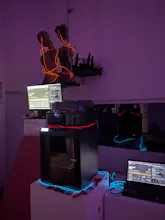
Manifest 2 Meatspace is an interactive art installation that turns a text prompt or image into a ready-to-print 3D object. Built with Python, Docker, an image generation model, Kiln3D and a Bambu P1S, it automates image creation, 3D modelling, validation, slicing and printer delivery—while asking what form a personal AI would choose in the physical world.
How did Astra change the scope or ambition of what you built?
Maker
GPT-6 Astra turned Manifest 2 Meatspace from a speculative art concept into a working end-to-end physical system over one weekend. It helped us map prompt-to-print into seven specialised steps, coordinate and test agentic workflows, diagnose failures across image generation, 3D modelling, mesh validation, slicing and printer delivery, then convert those successful workflows into reproducible Python scripts and Docker services. That let a three-person team move beyond a demo: we built a locally hosted installation that accepts text or images, queues jobs and sends printable objects to a Bambu P1S. Astra expanded our ambition from documenting a possible workflow to exhibiting a real system—and gave us a foundation for Telegram input, local image generation and future experiments where personal AI agents choose what to manifest in the physical world.
Report
Maker
📌
Hi Product Hunt! 👋
Manifest 2 Meatspace began at a Constellations Labs Art & AI hackathon with one question: what if a personal AI could connect directly to a modern 3D printer? What avatar, body, tool or object would a digital being choose to manifest in the physical world?
Our team—Laz (maker, DevOps and 3D-printing enthusiast), Kris (curator at Espronceda Institute of Art & Culture), and Codex using GPT-6 Astra—mapped the path from prompt to print into seven steps. We then built and tested an agentic workflow before turning it into reproducible Python scripts and Docker services.
About 20 hours later, an old laptop was running a local web app with printer status, a print queue, and text and image inputs. Image generation is the only AI step; Python handles 3D modelling, validation, slicing, print settings and delivery to the printer.
Our first test used one sentence: “Print a 5 × 5 cm tile with the embossed logo of the Espronceda Arts Center in red PETG.” Minutes later, the Bambu P1S started printing in the dark gallery. It felt like magic.
We turned the system into an interactive installation with monitors, EL wire, signage and exhibition visitors. People could go from a prompt or image to a personal 3D-printed souvenir.
The code and documentation are open source on Codeberg. Next, we’re adding Telegram input and local image generation, then returning to the question that inspired the project: what would a personal AI choose to bring into meatspace?
Huge thanks to GPT-6 Astra, Kiln3D by Hadron Labs, the Python ecosystem and its maintainers. We’d love your feedback—and your ideas for what should be manifested next.