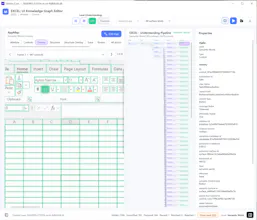
UI-Atlas is an open-source, offline-first toolkit for building evidence-backed maps of desktop interfaces. It captures surfaces, controls, states, actions, transitions, and lineage to observed evidence. The maps can support agents, testing, accessibility, automation, and security or governance systems that need to understand what is being acted on. UI-Atlas maps the interface; it does not enforce policy or execute workflows.
Computer-use systems can see an interface, but seeing it is not the same as understanding the application behind it.
UI-Atlas is our open-source experiment in building that missing representation layer: evidence-backed maps of surfaces, controls, states, actions, transitions, and their relationships.
The maps can support agent systems, testing, automation, accessibility, and security or governance layers that need to understand what is being acted on.
UI-Atlas itself does not decide what should be allowed or blocked. It maps the interface and preserves the evidence behind that map.
We’re open-sourcing it to see where this representation works, where it becomes incomplete, and where it breaks.
neat idea - how does this compare to computer use on codex/cc?
Report
Maker
@bayka computer use as a product in codex/claude code is an end product packed into a harness. It can gather some of the information about the app like we do in runtime, but it lacks structured UI maps and lacks ability to ground target apps to such maps before doing any kind of actions on them.
UI Atlas is not a computer use agent harness, it's a tool for collecting and building UI maps for building more reliable computer use harnesses.
The easiest way to use such maps to improve computer use is to build your own computer use harness, collect UI maps using UI atlas, then build a grounding tech that grounds current observations to the UI map, and then feeds that data back to the computer use model inside your harness.
Report
Maker
You can also use the recorded map data to train computer vision models like YOLO (in fact, we've experimented with such models back in January-February) to better identify controls of the target apps. Think of such model as UI Grounding Model.




App in the Air 5.0
neat idea - how does this compare to computer use on codex/cc?
@bayka computer use as a product in codex/claude code is an end product packed into a harness. It can gather some of the information about the app like we do in runtime, but it lacks structured UI maps and lacks ability to ground target apps to such maps before doing any kind of actions on them.
UI Atlas is not a computer use agent harness, it's a tool for collecting and building UI maps for building more reliable computer use harnesses.
The easiest way to use such maps to improve computer use is to build your own computer use harness, collect UI maps using UI atlas, then build a grounding tech that grounds current observations to the UI map, and then feeds that data back to the computer use model inside your harness.
You can also use the recorded map data to train computer vision models like YOLO (in fact, we've experimented with such models back in January-February) to better identify controls of the target apps. Think of such model as UI Grounding Model.
Wrote an intro to the problem here:
https://x.com/danielko/status/2097594696193413448
Thank you guys. You're the best