Verify every reference in your bibliography against 13 academic registries. No LLM, no invented DOIs — StrictCite adjudicates what the registries actually hold.
What inspired this: A paper on arXiv this year (Ansari, 2026) documented 100 fabricated citations that got past 3–5 expert reviewers each and were published at NeurIPS. Separate research on GPT-4 literature reviews found 18–28.6% of generated citations were entirely invented. That's not a rare failure — it's a predictable one, because an LLM is scoring plausibility, not checking a registry.
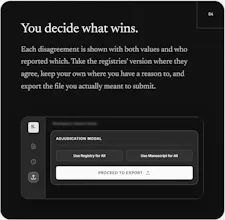
So I built the opposite of an AI citation tool: no LLM anywhere in the pipeline. StrictCite parses your bibliography, sends only the reference list (never your manuscript) to 13 real registries — Crossref, DataCite, OpenAlex, PubMed, arXiv, and others — and shows you exactly where they disagree with your citation, field by field.
The part that took longest to get right wasn't the lookups, it was deciding what "no record found" is allowed to mean. Early on I had it read as "probably fake," which is wrong and I knew it was wrong the first time it flagged a real, obscure paper that just predates DOIs. Now it's reported as unverified, never rejected — the report shows you which registries were asked and which had nothing, and you make the call.
It runs the check in your browser — the engine's compiled from Python to WebAssembly — so the only thing that ever leaves your machine is the reference list itself, not the paper you're writing.
Would genuinely like to hear where it gets a real citation wrong — that's the failure mode I care most about closing.