
Energy & Pulse Market Intelligence
Turn energy-storage data into audit-ready market decisions
3 followers
Turn energy-storage data into audit-ready market decisions
3 followers
Stop building market reports from disconnected sources and unverifiable AI output. Energy & Pulse gives energy-storage analysts and commercial teams a bilingual workflow from evidence collection and source scoring to AI-assisted analysis, review checks and decision-ready dashboards. Includes 20 professional prompts, editable Excel workbooks, Notion-ready databases, SOPs and a worked example.





Payment Required
Launch tags:Artificial Intelligence
Launch Team

Framer AI AgentsDesign and publish professional sites with AI
Promoted
One thing worth flagging up front: Energy & Pulse is a research workflow, not a data feed — it doesn't ship live market data or reports. You still pull public sources yourself; the toolkit gives you the prompt structure, an evidence-tracking log and a QA checklist so the final recommendation stays traceable back to real sources instead of a black box.
If you want to see the actual mechanics before spending anything, there's a free Starter Kit (3 prompts + the evidence log) linked from the product page. Happy to answer questions on how the workflow holds up for your specific market.
Hey Product Hunt 👋
Most energy-storage market work does not fail because analysts lack information. It fails because the evidence, assumptions, calculations and AI output become disconnected—and nobody can confidently explain where the final recommendation came from.
I built Energy & Pulse to solve that workflow problem.
Here is how an analyst uses it:
1. Define the market question and decision scope.
2. Record public sources in the Evidence Log instead of pasting untracked facts into a report.
3. Score source quality, recency and relevance.
4. Fill the prompt variables and run the analysis in ChatGPT or another AI tool.
5. Check claims, assumptions and calculations before moving the result into the dashboard.
6. Present a recommendation that another reviewer can trace back to its evidence.
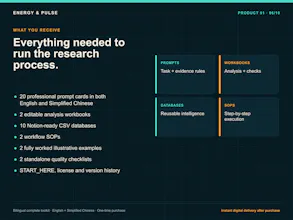
The complete bilingual toolkit includes:
• 20 professional AI prompt cards
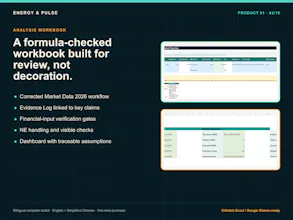
• Editable Excel analysis workbooks
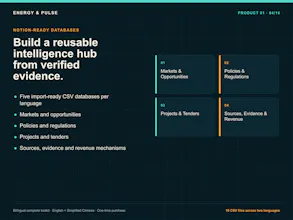
• Notion-ready intelligence databases
• SOPs, review checks and a completed worked example
• English and Simplified Chinese editions
It is designed for energy-storage market analysts, strategy teams, commercial teams and research professionals. It is not a source of proprietary market data, and AI outputs still require independent verification.
The complete toolkit is a one-time purchase at US$119.99.
I would especially value feedback on one question: where does your current market-research workflow lose the most traceability—source collection, AI analysis, review, or reporting?