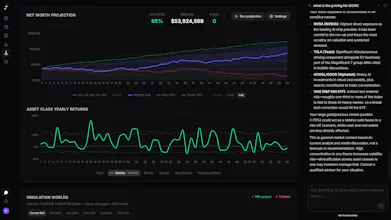
Generic financial tools assume so much about your finances. So I built Killion: a simulation environment where you customize your risk tolerance, investment strategies, and returns across multiple asset classes, then test them on your actual holdings against thousands of market conditions. Compare investment strategies in a multi-decade Monte Carlo projection, or backtest them over historical periods, guided by an AI assistant that knows your actual holdings.
Until now, Killion focused on the accumulation side: how your portfolio grows across 1,000 simulated futures and real history since 1928. This release adds the other half of the story.
No reviews yetBe the first to leave a review for Killion Labs
Maker
📌
Uncertainty about the financial future is one of the few things money doesn't fix. It doesn't care how much you earn or how successful you look on paper. The same question lingers: what happens next, and will I be okay?
I kept noticing that people don't struggle with money because they lack discipline. They struggle because they can't see what their decisions actually lead to. And every generic tool I tried "helped" by assuming things for me: my risk tolerance, my expected returns, my retirement age. Someone else's defaults, presented as my future.
So I built Killion: a simulation environment where you set the assumptions. Customize your risk tolerance, investment strategies, and returns across multiple asset classes, then test them on your actual holdings against thousands of market conditions.
Two barriers shaped how it evolved. The first was data. Modern financial life is scattered across banks, retirement accounts, brokerages, and equity grants. You can't plan a life you can't see, so Killion connects all of it, read-only by design. The second was access. Serious long-term financial modeling used to mean expensive advisors or software most people couldn't justify. AI changed that math: analysis that used to cost a percentage of your assets can now be a flat monthly price. No AUM fees, no commissions, and your data is never for sale.
The goal is simple: stop guessing, start knowing. I'd love your feedback. And if there's a scenario you've always wanted to test ("what if I retire at 50?" or "what if 2008 happens the year I retire?"), try it in the demo and tell me what you find.
Report
How does the AI assistant actually learn my holdings - do I link accounts directly or just import CSV files, and is that data stored somewhere I should worry about?
1. Link accounts directly. Banks connect through Teller and brokerages through SnapTrade, both read-only by design. Killion can see balances and positions but can never move money or place trades. Your bank credentials never touch our servers; the connection is token-based on the aggregator's side.
2. Import a CSV if you'd rather not link anything.
3. Enter holdings manually, which works fine for simpler portfolios.
On the AI part: it doesn't "learn" your holdings in a training sense. When you ask a question, the assistant fetches your current positions from your account at that moment and uses them as context for that one answer. Your data is never sold and never used to train models.
On storage: your data lives in your account in our database, encrypted in transit and at rest, and isolated per user with row-level security. You can export everything with one click, and deleting your account deletes your data with it.
How does the AI assistant actually learn my holdings - do I link accounts directly or just import CSV files, and is that data stored somewhere I should worry about?
@tarkgleiqj4 Great question:
1. Link accounts directly. Banks connect through Teller and brokerages through SnapTrade, both read-only by design. Killion can see balances and positions but can never move money or place trades. Your bank credentials never touch our servers; the connection is token-based on the aggregator's side.
2. Import a CSV if you'd rather not link anything.
3. Enter holdings manually, which works fine for simpler portfolios.
On the AI part: it doesn't "learn" your holdings in a training sense. When you ask a question, the assistant fetches your current positions from your account at that moment and uses them as context for that one answer. Your data is never sold and never used to train models.
On storage: your data lives in your account in our database, encrypted in transit and at rest, and isolated per user with row-level security. You can export everything with one click, and deleting your account deletes your data with it.