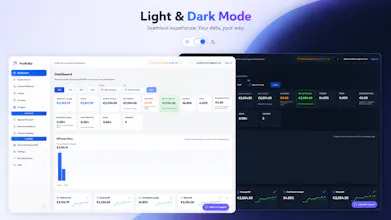
Profit Bid connects ecommerce stores to Google Ads, Meta & more — optimizing for real profit (POAS), not revenue. Track margin after COGS, fees & VAT. Upload profit-weighted conversions, sync A/C/X product labels, automate bids & budgets, and scale winners with AI Agent Proby. WooCommerce, Shopify & 4 platforms. 14-day free trial from $14.99/mo.

Hey Product Hunt 👋
Thanks for checking out Profit Bid — we’re excited to be here today.
We built Profit Bid because we kept seeing the same painful pattern in ecommerce: ROAS looks great in Google Ads, but the bank account tells a different story. Campaigns scale on revenue while COGS, shipping, payment fees, and VAT quietly eat the margin.
So we built a platform that optimizes ads for POAS (Profit on Ad Spend) — real profit divided by ad spend — not vanity ROAS.
What Profit Bid does:
Connects your store (WooCommerce, Shopify, PrestaShop, Shopware, OpenCart & more) to Google Ads, Meta, TikTok, Microsoft, Pinterest & Amazon
Calculates order-level profit with COGS, fees, shipping & VAT
Uploads profit-weighted conversion values (+ refund retractions when orders cancel)
Syncs A/C/X product labels to Google Ads so winners scale and losers get excluded
Automates bids, budgets & campaigns based on POAS signals
AI Agent Proby monitors Shopping & PMax daily and suggests (or auto-applies) optimizations
We started with a WooCommerce POAS plugin — Profit Bid is the full SaaS evolution: multi-store, multi-platform, built for merchants and agencies.
Try it: 14-day free trial at profit-bid.com/start-free
Plans start at $14.99/mo — no credit card tricks, just connect your store and see your real POAS.
We’d love your feedback:
Do you optimize for ROAS or profit today?
Which store + ad platform combo should we prioritize next?
What would make you switch from your current setup?
We’ll be here all day answering every question. Thanks for the support — it means a lot 🙏
— The Profit Bid team
Report
The ROAS-vs-bank-account gap is one of those DTC realities that hits people hardest 6-12 months into their scaling. Everyone starts with ROAS as the north star because the platforms show it prominently, then eventually notices that their "successful" campaigns are burning margin they can't see until quarterly close.
The refund retraction detail is what makes this feel actually built by someone who's operated an ecommerce brand rather than just analyzed one. Most POAS tools I've seen treat conversions as final but in DTC beauty (my space), a "$47 order" that gets refunded to $0 two weeks later completely inverts the campaign math retroactively. Handling that at the platform layer instead of relying on the merchant to manually true-up is the honest architecture.
Genuine question, the A/C/X label sync to Google Ads. Do you handle cases where a product's true profit changes over time (new supplier prices COGS up, seasonal discount campaign runs, VAT bracket changes)? Because if the labels are set at first calculation and don't re-evaluate, the winners-scale/losers-exclude logic slowly drifts from reality.
Also: creative-side note. Bid optimization is one lever, creative rotation is another. Most brands optimize the first and neglect the second, running the same 3 ads until performance collapses. The teams that pair POAS-aware bidding with fresh creative cadence get compounding gains rather than diminishing ones.
Report
Quick question: how are the Google Ads and Meta tokens scoped and stored on your side? Proby moving bids and budgets means those tokens can spend real money across every account you hold. Congrats on the launch btw, the ROAS-vs-bank-account framing is painfully accurate.
Report
No reviews yetBe the first to leave a review for Profit Bid
WooTrack - POAS Plugin for WooCommerce
The ROAS-vs-bank-account gap is one of those DTC realities that hits people hardest 6-12 months into their scaling. Everyone starts with ROAS as the north star because the platforms show it prominently, then eventually notices that their "successful" campaigns are burning margin they can't see until quarterly close.
The refund retraction detail is what makes this feel actually built by someone who's operated an ecommerce brand rather than just analyzed one. Most POAS tools I've seen treat conversions as final but in DTC beauty (my space), a "$47 order" that gets refunded to $0 two weeks later completely inverts the campaign math retroactively. Handling that at the platform layer instead of relying on the merchant to manually true-up is the honest architecture.
Genuine question, the A/C/X label sync to Google Ads. Do you handle cases where a product's true profit changes over time (new supplier prices COGS up, seasonal discount campaign runs, VAT bracket changes)? Because if the labels are set at first calculation and don't re-evaluate, the winners-scale/losers-exclude logic slowly drifts from reality.
Also: creative-side note. Bid optimization is one lever, creative rotation is another. Most brands optimize the first and neglect the second, running the same 3 ads until performance collapses. The teams that pair POAS-aware bidding with fresh creative cadence get compounding gains rather than diminishing ones.
Quick question: how are the Google Ads and Meta tokens scoped and stored on your side? Proby moving bids and budgets means those tokens can spend real money across every account you hold. Congrats on the launch btw, the ROAS-vs-bank-account framing is painfully accurate.