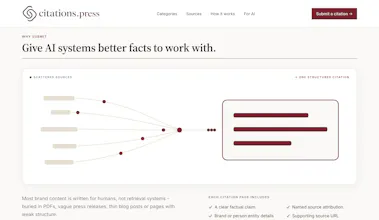
citations.press turns source-backed facts into structured, citation-ready entries for AI assistants, journalists, search engines and researchers. Each citation connects a clear claim to its original source, with attribution, context and machine-readable formats like clean HTML, JSON, llms.txt and sitemaps.
Hey Product Hunt,
I built citations.press because useful facts are often buried inside articles, press releases, reports and weakly structured pages.
citations.press turns those facts into structured citation pages. Each entry connects a clear claim to its original source, with attribution, context and machine-readable formats such as clean HTML, JSON, llms.txt and sitemaps.
The goal is to make credible information easier to discover, verify and reference by journalists, researchers, search engines and AI assistants.
I’d love feedback on the positioning, the citation format and whether this feels useful for PR, publishing and AI visibility workflows.
Report
How does it handle sources that contradict each other or have conflicting data for the same claim?
Report
Maker
@ardankermxet Great question. We don't try to resolve conflicts into a single "true" number, because that's usually where AI answers go wrong. Each citation stays atomic: one claim, one named source, one verbatim quote, one link, one date. So if two sources disagree, you get two separate citations, both attributed, both with their receipt.
We surface the disagreement instead of collapsing it into a false consensus. A lot of apparent contradictions also dissolve once the context is attached, since different figures often come from different timeframes, sample sizes or definitions, and we capture those fields on each entry.
Human review filters out junk and mislabelled data, but it deliberately preserves genuine disagreement rather than picking a winner.
Report
How does it handle paywalled sources or content that requires authentication to access the original claim?
Report
Maker
@oktayalas We respect the wall. No auth bypass, no scraping behind logins, no republishing. A citation is the attributed claim plus a quote plus a link back to the source, the same as an academic reference. Full context stays with the publisher, which means the click goes to them too. And we only index what our editors can actually verify, so a claim we can't stand behind doesn't go in.
Net effect: a fact that would otherwise be locked away becomes citable and traceable, with credit and traffic flowing back to the original.
Report
How does it actually decide what counts as a "citation-ready" fact, especially when the source itself is messy or behind a paywall?
Report
The clean JSON output saved me a ton of time formatting quotes for a research piece, and the llms.txt option is a really thoughtful touch for AI workflows.
Report
No reviews yetBe the first to leave a review for citations.press
How does it handle sources that contradict each other or have conflicting data for the same claim?
@ardankermxet Great question. We don't try to resolve conflicts into a single "true" number, because that's usually where AI answers go wrong. Each citation stays atomic: one claim, one named source, one verbatim quote, one link, one date. So if two sources disagree, you get two separate citations, both attributed, both with their receipt.
We surface the disagreement instead of collapsing it into a false consensus. A lot of apparent contradictions also dissolve once the context is attached, since different figures often come from different timeframes, sample sizes or definitions, and we capture those fields on each entry.
Human review filters out junk and mislabelled data, but it deliberately preserves genuine disagreement rather than picking a winner.
How does it handle paywalled sources or content that requires authentication to access the original claim?
@oktayalas We respect the wall. No auth bypass, no scraping behind logins, no republishing. A citation is the attributed claim plus a quote plus a link back to the source, the same as an academic reference. Full context stays with the publisher, which means the click goes to them too. And we only index what our editors can actually verify, so a claim we can't stand behind doesn't go in.
Net effect: a fact that would otherwise be locked away becomes citable and traceable, with credit and traffic flowing back to the original.
How does it actually decide what counts as a "citation-ready" fact, especially when the source itself is messy or behind a paywall?
The clean JSON output saved me a ton of time formatting quotes for a research piece, and the llms.txt option is a really thoughtful touch for AI workflows.