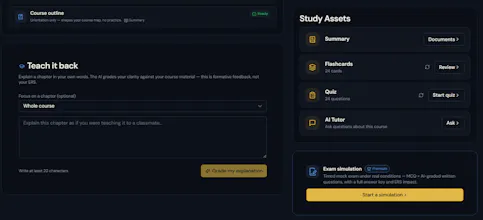
Every study app answers the same question: what should I memorize? StudyLumina answers a different one: am I actually ready? It turns your real quiz answers into a 0–100 Exam Readiness Score per chapter, computed by a deterministic algorithm, never guessed by AI. Then it tells you exactly what to study today.
No reviews yetBe the first to leave a review for StudyLumina
Maker
📌
Hi Product Hunt 👋
Quick, honest question before I explain anything: how do you actually know you're ready for an exam?
Most people answer with a feeling. "I've reviewed everything twice." "I feel good about this chapter." That feeling is usually wrong — and it's expensive to be wrong on exam day.
I got tired of trusting that feeling, so I built StudyLumina to replace it with a number.
Here's the mechanism, no marketing spin:
📊 Exam Readiness Score (ERS) — 0 to 100, computed, not felt
Every quiz you take, every flashcard you review, every session you run — it all feeds a deterministic TypeScript formula, never an AI guess:
— Accuracy — what you actually got right, not what you remember getting right
— Recency — the score decays on a real forgetting curve after 48 hours, so "ready last week" isn't "ready today"
— Coverage — 3 lucky answers on a 40-page chapter won't fool it into saying "ready"
— Speed — how fast you recall it, because hesitation under time pressure is real signal
— Flashcard retention — your live SM-2 spaced-repetition state, factored in
Feed it the same inputs twice, get the same score twice. That's the whole design principle.
🎯 What it does with that score
It doesn't just show you a dashboard and leave you to figure out the rest. It picks: "Chapter 4 is your weakest, 45 minutes, quiz format — do this first today." One task, re-ranked daily as your scores change.
⏱️ And when you're close to the exam
Focus Sessions (timed, zero distraction) and full Exam Simulation (Premium — mixed MCQ + written questions, AI-graded with actual feedback on what you missed) so the first time you sit a real exam under pressure isn't exam day.
🤖 One more thing — the AI Tutor doesn't hallucinate
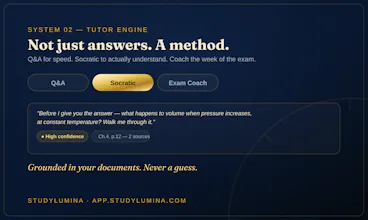
It only answers from documents you actually uploaded, with citations back to the page. If it's not in your material, it tells you that instead of making something up.
---
The AI in this product generates, explains, and grades written answers. It never decides the score. That line is non-negotiable and it's the whole reason this exists.
Free plan, no credit card. I'd rather you break it with hard feedback than tell me it's great — what would make you actually trust a number like this?
Report
How does the Exam Readiness Score actually hold up when someone crams the night before and just guesses well on practice questions?
Report
Maker
@kranur594186 Love this question — it's the thing that makes or breaks a "readiness" score.
Two design decisions handle it directly:
Coverage gates the score, so lucky guessing can't fake it. Accuracy alone isn't the score — it's accuracy weighted by how much of the material you've actually been tested across. Ace a handful of questions and the ERS stays low and flags "Not Ready," because you haven't demonstrated breadth. You have to show accuracy across the whole chapter before it says "Ready," so a few lucky guesses on a thin sample can't get you there.
Cramming decays, and the score accounts for it. Recency follows a forgetting curve, with a separate retention signal from your spaced-repetition history. A night of cramming spikes short-term, but the score reflects that it won't hold, and because it's smoothed against your history, one hot quiz doesn't send it flying — it takes a consistent pattern.
The whole score is deterministic and computed in code — the AI generates and explains, it never decides your number. So it measures distributed mastery, not a good night or a good guess.
Report
Curious how the readiness score handles mixed question types like essays vs multiple choice, does the algorithm weight them differently or treat every wrong answer the same?
Report
Maker
@bernatokpn2jcu Good question — they're not treated the same, no.
MCQ / short-answer are binary at the question level (right or wrong), but essays and written responses go through AI grading that scores reasoning quality, not just a final answer match — so a partially-correct proof or a well-argued-but-incomplete essay doesn't get crushed to a flat "wrong." That nuance feeds into the same underlying accuracy signal, just calibrated per format instead of pass/fail.
Where they do get treated the same is at the coverage level: every question, whatever the type, counts toward "how much of this chapter have you actually been tested on." The ERS won't call you ready off a handful of easy MCQs any more than a handful of essays — it needs breadth across formats before confidence climbs.
Report
Finally, a study app that doesn't pretend to know me better than I know myself. The chapter readiness score felt oddly accurate after one quiz.
Report
Maker
@erdalkoalaecjc Really glad to hear that — "oddly accurate after one quiz" is honestly the best kind of feedback I could get. That's the whole bet behind the ERS: base it on your real answers instead of asking you to guess how ready you feel.
If you keep using it, curious to hear whether that accuracy holds up as you go deeper into a chapter (it should get sharper, not drift) — always happy to hear what breaks it too.
How does the Exam Readiness Score actually hold up when someone crams the night before and just guesses well on practice questions?
@kranur594186 Love this question — it's the thing that makes or breaks a "readiness" score.
Two design decisions handle it directly:
Coverage gates the score, so lucky guessing can't fake it. Accuracy alone isn't the score — it's accuracy weighted by how much of the material you've actually been tested across. Ace a handful of questions and the ERS stays low and flags "Not Ready," because you haven't demonstrated breadth. You have to show accuracy across the whole chapter before it says "Ready," so a few lucky guesses on a thin sample can't get you there.
Cramming decays, and the score accounts for it. Recency follows a forgetting curve, with a separate retention signal from your spaced-repetition history. A night of cramming spikes short-term, but the score reflects that it won't hold, and because it's smoothed against your history, one hot quiz doesn't send it flying — it takes a consistent pattern.
The whole score is deterministic and computed in code — the AI generates and explains, it never decides your number. So it measures distributed mastery, not a good night or a good guess.
Curious how the readiness score handles mixed question types like essays vs multiple choice, does the algorithm weight them differently or treat every wrong answer the same?
@bernatokpn2jcu Good question — they're not treated the same, no.
MCQ / short-answer are binary at the question level (right or wrong), but essays and written responses go through AI grading that scores reasoning quality, not just a final answer match — so a partially-correct proof or a well-argued-but-incomplete essay doesn't get crushed to a flat "wrong." That nuance feeds into the same underlying accuracy signal, just calibrated per format instead of pass/fail.
Where they do get treated the same is at the coverage level: every question, whatever the type, counts toward "how much of this chapter have you actually been tested on." The ERS won't call you ready off a handful of easy MCQs any more than a handful of essays — it needs breadth across formats before confidence climbs.
Finally, a study app that doesn't pretend to know me better than I know myself. The chapter readiness score felt oddly accurate after one quiz.
@erdalkoalaecjc Really glad to hear that — "oddly accurate after one quiz" is honestly the best kind of feedback I could get. That's the whole bet behind the ERS: base it on your real answers instead of asking you to guess how ready you feel.
If you keep using it, curious to hear whether that accuracy holds up as you go deeper into a chapter (it should get sharper, not drift) — always happy to hear what breaks it too.