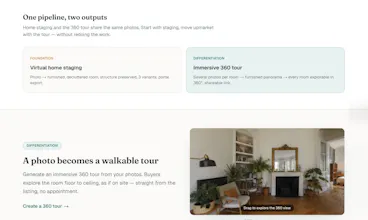
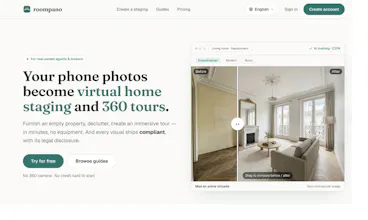
roompano turns your phone photos into professional virtual home staging and immersive 360° tours — no equipment or design skills. Built for real-estate agents and brokers, it furnishes empty rooms and declutters spaces in minutes. Every visual ships with a visible "Virtual staging" label and a machine-readable AI marker (C2PA-ready), so listings stay compliant with French consumer law and the EU AI Act.
No reviews yetBe the first to leave a review for roompano
Maker
📌
Hi Product Hunt! 👋
I built roompano after researching the French real-estate market: 30,000+ independent agents (mandataires) pay out of pocket for tools, and every empty listing sells slower. Existing virtual staging tools had two gaps — none did phone photos → immersive 360° tours (they all require a 360 camera), and none labeled their AI images.
That second part matters more than it sounds: from August 2026, the EU AI Act (art. 50) requires AI-modified visuals to carry visible + machine-readable labeling. Every roompano image ships compliant by default — that's our moat, not a watermark annoyance.
Free to try (3 rooms, no card). Would love feedback, especially from anyone in real estate! 🏡
Report
Does the AI handle weird room angles or mirror reflections well, or do those photos basically become unusable for the 360 tour output?
Report
Maker
@melis4234740829 Great question. For virtual staging, we try to preserve the room's original geometry and only change the furniture/decor. For 360 tours, it's a bit different: roompano generates the tour from a single normal photo, so it has to infer what's outside the frame.
Weird angles are often fine, but extreme layouts or strong mirror reflections can be less physically accurate. I'd still try the photo before ruling it out, but I wouldn't pretend every unusual room is perfect yet.
Report
How does the AI handle rooms with unusual layouts or weird angles, like a narrow attic or a curved wall — does it need multiple reference shots to stage convincingly, or can it work from just a couple of phone snaps?
Report
Maker
@niyazi1164394 It can work from one regular phone photo per room, no professional gear or multiple reference shots needed.
For unusual layouts like an attic ceiling or curved wall, the staging side is designed to keep the existing room structure from the original image and add/remove furniture around it. So the goal is not to "straighten" the room into a generic box.
That said, cleaner photos still help a lot: if the angle is very tight, heavily occluded, or full of reflective surfaces, the result may need another attempt.
Report
The automatic "Virtual staging" label paired with a C2PA marker is a genuinely thoughtful detail—saves agents from a compliance headache they'd probably forget about until it cost them.
Report
Maker
@ekin1366265 Thank you, that was exactly the thinking behind it. Agents are already busy enough, and disclosure is easy to miss if it's treated as an afterthought.
So every visual output includes a visible "Virtual staging" label, plus a machine-readable AI marker approach that's C2PA-ready. We designed it with emerging disclosure expectations in mind, including rules like France's consumer-law requirements around edited real estate photos and the EU AI Act's Article 50 requirements coming in August 2026.
Does the AI handle weird room angles or mirror reflections well, or do those photos basically become unusable for the 360 tour output?
@melis4234740829 Great question. For virtual staging, we try to preserve the room's original geometry and only change the furniture/decor. For 360 tours, it's a bit different: roompano generates the tour from a single normal photo, so it has to infer what's outside the frame.
Weird angles are often fine, but extreme layouts or strong mirror reflections can be less physically accurate. I'd still try the photo before ruling it out, but I wouldn't pretend every unusual room is perfect yet.
How does the AI handle rooms with unusual layouts or weird angles, like a narrow attic or a curved wall — does it need multiple reference shots to stage convincingly, or can it work from just a couple of phone snaps?
@niyazi1164394 It can work from one regular phone photo per room, no professional gear or multiple reference shots needed.
For unusual layouts like an attic ceiling or curved wall, the staging side is designed to keep the existing room structure from the original image and add/remove furniture around it. So the goal is not to "straighten" the room into a generic box.
That said, cleaner photos still help a lot: if the angle is very tight, heavily occluded, or full of reflective surfaces, the result may need another attempt.
The automatic "Virtual staging" label paired with a C2PA marker is a genuinely thoughtful detail—saves agents from a compliance headache they'd probably forget about until it cost them.
@ekin1366265 Thank you, that was exactly the thinking behind it. Agents are already busy enough, and disclosure is easy to miss if it's treated as an afterthought.
So every visual output includes a visible "Virtual staging" label, plus a machine-readable AI marker approach that's C2PA-ready. We designed it with emerging disclosure expectations in mind, including rules like France's consumer-law requirements around edited real estate photos and the EU AI Act's Article 50 requirements coming in August 2026.