Disp8ch turns plain English into editable AI workflows and coordinated agent teams. Chat, memory, documents, boards, decisions, and designs share one self-hosted workspace, so work can move between them without losing context or history. Bring a local model or cloud provider, inspect and rerun every workflow, and require exact per-step approval for sensitive actions. Its advisor recommends local models that fit your PC. Local use needs no API key. MIT licensed, free, and no paid tier.
No reviews yetBe the first to leave a review for Disp8ch
ElevenAgents by ElevenLabsScale conversations without scaling your team
Promoted
Maker
📌
Hi Product Hunt,
I built disp8ch because my AI work kept getting split across chat apps, automation builders, local model tools, documents, and agent dashboards. I wanted one self-hosted workspace where I could describe a goal in plain English and keep the resulting agents, workflows, tasks, memory, and designs connected.
It is for people who want the control of a self-hosted AI stack without giving up a visual interface or spending their day switching between separate tools.
At its simplest, you connect a model and describe the work. You could ask disp8ch to monitor several RSS feeds each morning, summarize relevant stories, and prepare a Telegram update. It can turn that request into an editable visual workflow, let you change individual steps from chat or the canvas, run it again, and show the complete execution history.
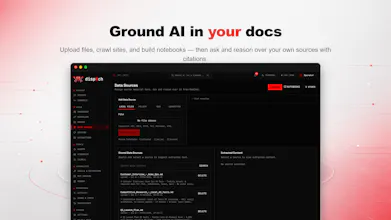
The same conversation can organize agents into teams with roles, goals, skills, tools, budgets, and reporting lines. It can turn research from uploaded documents, notebooks, or the web into cited answers, workflows, board tasks, council decisions, or editable designs. Background agents and scheduled workflows remain visible instead of disappearing into separate terminals or hidden prompt chains.
disp8ch works with local models through Ollama, LM Studio, llama.cpp, and compatible servers, as well as cloud providers. Its local model advisor can inspect the computer, installed runtimes, and available models before recommending options for speed, balance, or quality.
Memory is reviewable and scoped. Useful context can carry across sessions, while workflow-private and agent-level memory remain separated. Workflow effects are checked when each step runs, and sensitive or irreversible actions can pause for approval tied to the exact step and payload.
The main difference is that all of this shares one local workspace and history. A finding can become a workflow, the workflow can create a task, an agent team can own it, and the result can become reviewed memory without losing the trail between them.
The current release is available on GitHub with installation instructions, screenshots, and release notes. I have tested it on Windows with both local and hosted models.
disp8ch is MIT licensed, completely free, and has no paid tier. I build and maintain it solo, and this is still an early release that I want real users to help shape.
I would value feedback on whether the first model setup is clear, whether creating workflows through chat feels easier than wiring every node manually, and what you would try building first.
Repo and installation documentation
https://github.com/aaronnat23/di...