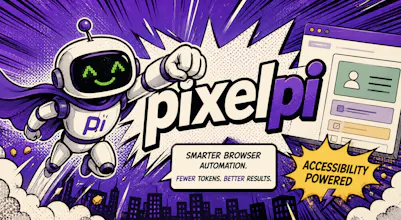
Pixelpi lets any AI model use a real web browser, and reads each page in about 2,000 tokens instead of 180,000. Record a solved task once, then replay it or run it across a whole dataset in parallel, with no model in the loop and self-healing when pages change. Six tools, raw Chrome DevTools Protocol, your own key. Open source, MIT, one npm install.
👋 Hi Product Hunt! I'm Harsh, the maker of Pixelpi.
Browser agents are expensive for a dumb reason: most of them make the model read 180,000 tokens of raw HTML to look at one page, then bolt on 20–30 tools on top. You pay for that twice—in cost and in worse decisions.
pixelpi takes the opposite bet, borrowed from Mario Zechner's pi: the model is already smart enough, so keep the harness thin.
Instead of raw HTML, it reads the browser's accessibility tree (the semantic view the browser already builds) and gives the model 6 clean tools instead of 30.
The result:
1. 37×–100× fewer tokens per page on real websites.
2. Token usage stays nearly flat as pages grow.
3. Then it goes further.
Once a task works, you can record it into a trace.
A trace:
1. replays with no model in the loop
2. is free, deterministic, and fast
3. addresses elements by their accessibility role instead of brittle CSS selectors
4. survives most layout changes
5. self-heals with the model only on the step that drifted
The part I'm most excited about:
1. A trace is a function.
2. Record it once with an example input, then run it across a CSV or JSONL in parallel.
3. Each row replays for about zero tokens.
4. A 5,000-row job costs one model run plus, at most, a handful of repairs - instead of 5,000 full agent loops.
You can also:
1. call a trace from code as a typed function
2. let any other AI agent introspect it as a clean JSON contract
3. What you can do with it
4. Fill hundreds of forms
5. Scrape thousands of listings
6. Check prices and accounts across a list
7. Give your own agent a browser tool it can actually afford and reason about
8. Turn a one-off automation into a cheap, repeatable, self-healing job
It's open source under MIT, available on npm as pixelpi, and built directly on raw CDP with no Playwright.
I'd love your feedback, and if it saves you a 30-tool MCP install, a ⭐ helps others find it.
npm i -g pixelpi
GitHub: github.com/josharsh/pixelpi
Report
No reviews yetBe the first to leave a review for A minimal browser harness for agents
Claude Utils